Historical
and Genealogical
Record
of
The Riley Family
and
The Barker Family
—— ★ ——
COPYRIGHT 1950
CLARA ELOISE RILEY
—— ★ ——
—— ★ ——
PRINTED BY
Walter D. Berry, Printing
Orangeburg, S. C.
—— ★ ——
INTRODUCTION
The following Historical Sketches have been compiled by the Sons and Daughters of Captain William Allen Riley and his wife, Pauline Barker Riley.
They wish to express their grateful appreciation to the older members and friends of the Riley and Barker families who have assisted them in obtaining such valuable information.
They also wish to express their gratitude for the privilege of reading—and qouting from—the following fine stories of this dear, fair land of Carolina:
Prince William’s Parish and Plantations—by John R. Todd and Francis M. Hutson. With Introduction by A. S. Salley.
Plantations of the Carolina Low Country—by Samuel Gaillard Stoney.
The Carolina Low Country—by Sass, Huger, Waring, Rutledge, Heyward.
A Day on Cooper River—by John B. Irving, M. D.—Louisa Cheves Stoney.
Liberal and just is the man who accepts
and lives by this old axiom.
Fair is he who does not criticise the tale
until he has read it through."
Some of Carolina’s Plantations and the Men who owned them.
Into the ancient Colony called Carolina came many men from the old countries of Europe—among them five men about whom this history is concerned:
These men, Miles Riley, James Myrick, William Ransome Barker, William Barton Ellis, and George Kirkland, came to Carolina in Colonial days—“when we lived under a king.”
Many motives, no doubt, prompted their coming to this grand, new land called America—to a new way of living in which a shining vision of life, liberty, and the pursuit of happiness might be realized. Some of them came with a great love of religious freedom in their souls, some of them came with high adventure in their hearts, some of them, especially the younger sons, came who had been the victims of oppressive land laws—knowing the poverty of over-taxation by the government of their home lands. And because these men, Irish, English, Scotch—all—had an abiding love of land in their veins, this history will have to tell of Plantations and, also, of Gardens—the ownership of land and the making of that land into fruitful fields and beautiful gardens.
“A peculiar country life trend given Carolina civilization by its early and numerous plantations is responsible for the importance and variety of many gardens, both living and vanished, that were planted through two hundred years as natural ornaments for great country estates in which centered the lives of the ruling classes; again for a deep, abiding love for the open country-side, for trees and shrubs and flowers, for the care and tending of gardens—basic elements—basic elements for that intense, passionate devotion to the native land that, throughout history, has distinguished Southerners, especially the sons and daughters of the native-born. The ancient garden worship is still a characteristic of the native-born from the sea-villages and cities to the high abodes of the blue mountains.
Throughout the Low and Middle Country plantation gardens, dating from the seventeenth to the middle of the nineteenth century, survive, some still in the hands of direct descendants of the original proprietors as at Magnolia and Middleton Gardens on the Ashley River, others being splendidly preserved by their present new owners, as at Mulberry Castle
on the Cooper River and the beautiful 'Gardens of the former Blake plantation on the Combahee River and also 'Harrietta' on the Santee'. Because the vast number of these restored gardens—of the Carolina Low Country—will continue an important note in the future spring garden symphony of America, and because their story is woven through two centuries of glowing plantation history, a glance through the closed chapters of plantation life is essential for a full appreciation of these gardens, both old and new.
Many things besides a love of gardens, that are the projected shadow of plantation generations, mark the Carolina of today. A system dating back to the first settlement, and maintaining through two centuries, could but leave deep impress, material and spiritual.
In the building of beautiful and spacious homes, the arrangement and adornment of private parks, avenues and gardens, one meets the natural reflexes engendered by the ownership of great estates; and by the dominion over numerous domestic and agricultural slaves—slavery on a vast scale being a necessary by-product of the plantation system. And not only social relations and political thinking but finally industrial development in this deep South have been modified by plantation traditions." (Carolina Gardens—by E. T. H. Shaffer)
"Even if you have no leaning towards the doctrine of predestination, the story of the 'Carolina Low Country' (by Samuel Gaillard Stoney) can almost persuade you that this coastal region of South Carolina was foreordained to plantations. You will find that they have been there as long as white men have lived in the region. The lay of the land, its ports, its climate, even the way its tidal rivers run, fitted it for them peculiarly. The men who settled it, the plans and ambitions that brought them and the successes that kept them here, and all the larger details of the history they and their successors made inclined the country to a spacious system.
Even the staples the plantations throve by seem to have entered more or less consciously into this scheme, for when one failed another was soon found to replace it. For instance, when rice—the crop par excellence of the region—tired out one sort of land, other methods and vaster richer kinds of land were found for growing it.
So well set was the system that it survived with some success the vio-
lent destruction of its natural era and died so slowly that a few Low (and Middle Country) plantations persisted until these last decades.—(Indigo, Rice, Silk, Cotton)
"That part of South Carolina which constitutes Beaufort County was the scene of the earliest known explorations of the coast of what is now South Carolina, made as early as 1525, and has almost continually since been the setting of a most fascinating, kaleidoscopic pageant of romantic history. In rapid succession we see Spaniards, Indians, Frenchmen, then Spaniards again, Englishmen, Scotchmen, and finally Englishmen who, after two centuries of conflicting interests engendering strife and blood-shed . . . brought tranquility to a section bountifully favored by nature, and developed there the prosperous and cultured community—Prince William's Parish and Plantations." (Salley's "Introduction, etc.—")
"In August, 1663, an expedition under William Hilton sailed on a voyage of exploration of the coast of Carolina in the interest of the Lords Proprietors of the newly chartered province of Carolina. He visited Port Royal and explored several of the inlets and rivers connected therewith. His name survives today in Hilton Head, which is believed by some historians to be Punta de Santa Elena, discovered and so named by Quexos, Spanish Explorer, in 1525, and Hilton Head Isand. In his Relation of his discoveries at Port Royal, Hilton says: 'Likewise we saw the Ruines of an old fort, compassing more than half an acre of land within the trenches, which we supposed to be Charles's Fort, built, and so called by the French in 1562, etc.' Of course it was the ruins of San Marcos that he saw."
After the settlement of Beaufort, named for the Duke of Beaufort, early in the eighteenth century, the ruins of San Marcos were discovered but were believed to be the ruins of Charlesfort which had been built by Jean Ribaut, and not until exploiting of the Spanish archives within the last ten years has it been definitely learned that these were the ruins of San Marcos and not Charlesfort. In 1917 the late General Eli K. Cole, commanding the Marine Station on Parris Island, had the parapets of San Marcos levelled, believing them to be survivals of the Confederate War. After he had wrought this useless destruction and he had been led to believe that those great parapets had been the walls of little Charlesfort, he had the old lines excavated and there were unearthed the butts of tell-tale Florida cedar palisades which Pedro Menendez Marques had planted there in 1577. Marques' policy with the Indians was a friendly one.
In 1562 Gaspard de Coligny of Chastillon, Admiral of France, sent out an expedition under Jean Ribaut, "a man in truth expert in sea causes", "to discover new and strange countrys." He sailed from Havre de Grace, France, the eighteenth of February, in two ships of the King of France, and on April 30, 1562, arrived on the coast of Florida.—He sailed northward along the coast until he discovered the great harbor of Santa Elena and the channel, he "entered safely therein" and found "one of the greatest and fayrest havens of the world", which, at high tide, "the greatest ships of France, yea, the Arguzes of Venice may enter in there," and because of the "fairnesse and largenesse thereof" he named it Port Royal. The next day he "commanded to put into the Pinessa a pillar of hard stone fashioned like a coloumne, wherein the armes of the King of France were graven, to plant the same in the fairest place that he could find." He discovered a creek into which he sailed and found that it returned to the great stream forming an island. On the island he set up the stone. He persuaded his men—a majority of them—to stay and garrison a fort. The island upon which this fort and garrison were placed is now known as Parris Island. The fort was named Charlesfort.
Philip II of Spain had learned, through his ambassador in Paris, of the fort and garrison at Port Royal, and of the marking pillar, and ordered the governor of Cuba to send a vessel to remove the pillar and, if possible destroy the fort. Hernando Manrique de Rojas, in command of the Frigate Nuestra Senora de la Concepcion, set out to execute the order. Rojas had the structure burnt to the ground and removed the stone bearing the arms of France, loaded on his ship and took it to Cuba,—it was subsequently taken to Seville."
In the summer of 1666 Robert Sanford, Secretary of Clarendon County, a settlement on the Cape Fear River (which was abandoned after two years) headed an expedition which also explored the region about Port Royal. In his Relations of a Voyage on the Coast of the 'Province of Carolina—from Charles River near Cape Fear to Port Royal'—he tells us of an Indian town—on an island—and Brayne Sound: The Island referred to was that which we now know as Parris Island. Brayne Sound was the name Sanford had given to what we now call Broad River.
On Parris Island a handsome Monument—supposedly marking the site of Charlesfort—has been erected by the United States Government.
Another intruder appeared ere long in the person of Sir Francis
Drake. Between English aggressions and renewed hostilities of the Indians, Spain at last withdrew its garrison from San Marcos in 1587.
The Scotch came later—1682. Some leaders among the Covenanters of Scotland, desirous of escaping the ever-increasing stringency of repressive legislation, began a movement for colonizing some of their suffering countrymen in America. Sir George Campbell of Cessnock and Sir John Cochran “made a bargain for two Counties with the Lords Proprietors of Carolina. The Scots called their settlement Stuart Town in compliment to the wife of Lord Cardross, who was Katherine Stuart, daughter of Sir James Stuart. The Scotchmen soon had a brisk trading with the Indians. Many of the Yamassee Indians settled near Port Royal, principally in what subsequently became Prince William’s Parish.
The earliest English government of Carolina was under the Lords Proprietors. A grant of the province known as Carolina was made by Charles II in 1663 to eight Proprietors, and in 1665 the grant was amended. These eight Proprietors were: Edward Hyde, Earl of Clarendon; George Monck, Duke of Albermarle; William, Lord Craven; Anthony, Lord Ashley; John, Lord Berkeley; Sir George Carteret, Sir William Berkeley, and Sir John Colleton. In 1669, Lord Ashley, later Earl of Shaftesbury, assumed a leading part among the Proprietors. In 1670, the settlement of Charles Town on the Ashley River was begun. In 1684 Henry Erskine, Baron Cardross, effected the settlement of a colony near the present site of Beaufort, which was called Stuart Town. This colony was destroyed in 1686 by the Spaniards from St. Augustine.
By an Act of the General Assembly, “mett at Charles Town,” in 1707, there was limited to the exclusive use of the Yamassee Indians the land which they then occupied “on the main bounded to the Northeast by Combahee River to the Southeast by the Marshes and Islands on Coosaw and Port Royal Rivers to the Southwest by the Savannah River and to Northwest by a line drawn from the Head of Combahee River to the Head of Savannah River and also one Island lying between the Pocosabo Town and the North Branch of Port Royal River commonly called Coosawhachee.—”
Prince William’s Parish was formed from a part of St. Helena’s Parish. Most of the families of the coastal section of South Carolina are closely allied through marriage.
In 1669, at the request of the Lords Proprietors, the celebrated John Locke, as secretary to Lord Ashley, drew up the Fundamental Constitu-
tions. Of particular significance in this constitution was the establishment of a nobility in the province of Carolina. This curious form of government provided by the Lords Proprietors for their Province is of interest both because it varied from those of the New England Colonies, and because, as a contributing factor to many of the subsequent developments in the province, traces of its influence survive today.
Under this system the estate of a Proprietor was known as a Seignory and consisted of 12,000 acres. A nobility was to be appointed by them, consisting of Landgraves and Cassiques. The estate of each of these was known as a Barony and contained 12,000 acres. There was a lesser division corresponding to the gentry of England known as Lords of the Manor, their estates to consist of not less than 3,000 and not more than 12,000 acres in one piece in a colony or precinct.
The great plantation age of the Low Country began with the conception of the idea of Carolina in the mind of a Barbadian planter, as a land for planters and plantations. Its actual commencement dates from the birth of the colony by the aid of an English country gentleman, a certain Sir John Colleton, who just after the Restoration brought the idea to London. He was an old Cavalier who had spent a fortune of £40,000 for the King, raised and fought a regiment at home in England, and, after defeat there, had gone to Barbados,—he became a planter.
In London Colleton associated to his scheme seven others who deserved much from King Charles. Two of these—George Monck, Duke of Albermarle, and Anthony Ashley-Cooper, then Lord Ashley—had accomplished more toward the Restoration than the others put together. The most of this company were already involved in a number of great colonial and trading promotions that were then spreading the British Empire to all quarters of the globe. As a basis for a new venture, Charles II readily granted them a vast and vastly unknown part of North America. In honor of the King, the Province was called Carolina,—and was ordered to be settled and ruled by it grantees as Lords Proprietors. ("Plantations of the Carolina Low Country"—by Samuel Gaillard Stoney).
Sir John Colleton, through his associates in Barbados, at first tried to settle on the Cape Fear River. His colony, after serving as a base for surveys and explorations of the coast to the southward, broke up and ended, and it was not until Sir John's death threw the control of Carolina
into the most able hands of Lord Ashley that the scheme began to work. From this man, the Low Country got a running start toward Plantations—and a good deal besides.
By the time that the three streams (two of which, the Ashley and the Cooper, were named for Lord Ashley) which flowed into Charles Town harbor were settled out in plantations, that town had established itself as the port of the Low Country, as well as its capital, its mother city, and the logical center of its life. Charles-Town (now Charleston), except for Beaufort and Georgetown and in spite of them, remained the place where you bought and sold seriously.
To this day if a Low Countryman says “town”, he means Charleston.
—— ★ ——
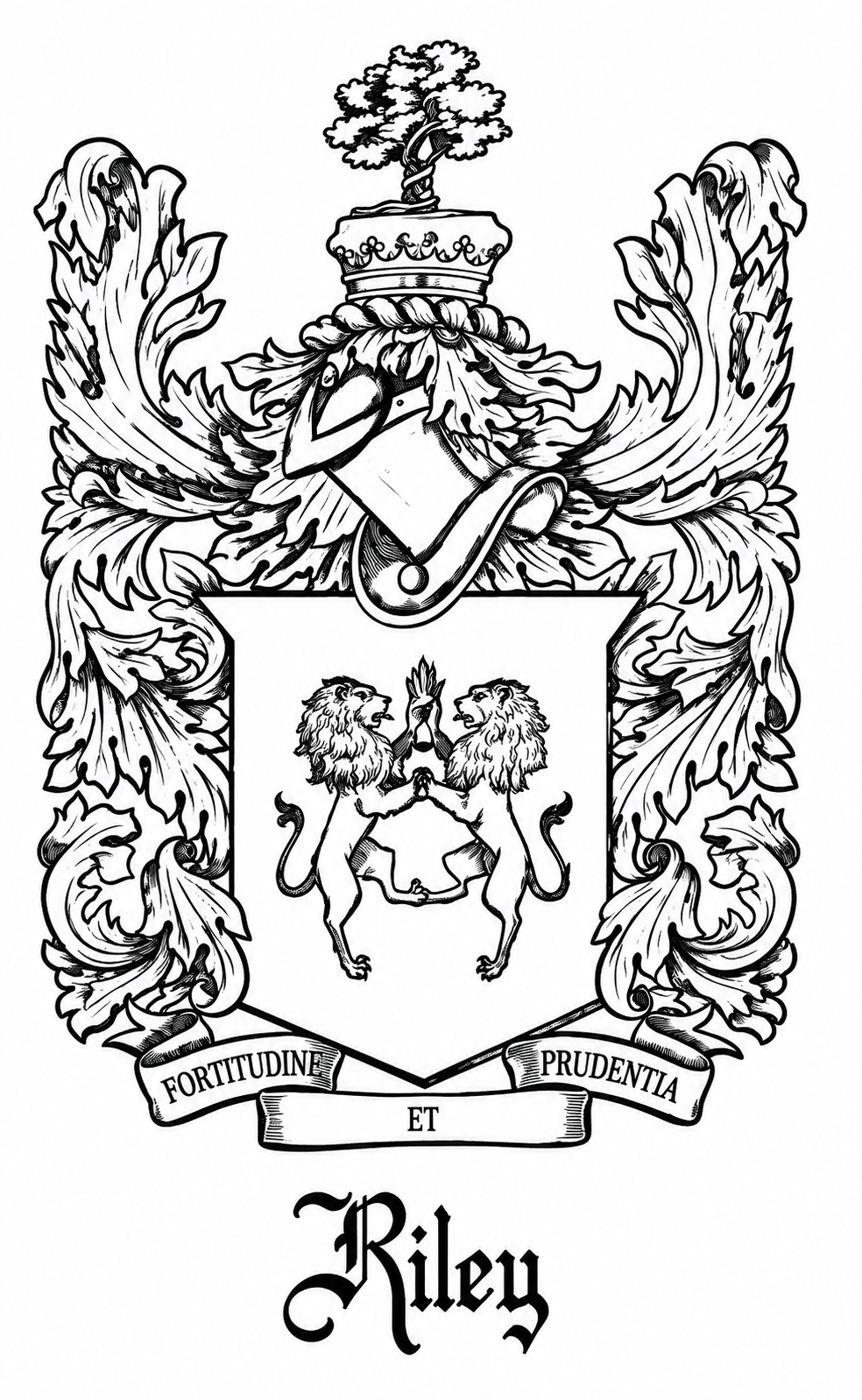
FORTITUDINE ET PRUDENTIA
Riley
The Riley Family of Erin is an illustrious one; the Clan O'Reilly took its origin from the Clan O'Rouke which in its turn took its origin from the Clan O'Connor. It is listed among the oldest of clan organizations in Ireland. This family has produced many notable sons and daughters in many parts of the world. Strange to relate (according to the genealogist R. Haskins Ellis) one O'Reilly was a Spanish general in the middle 18th century; Count Andrew O'Reilly was an Austrian field marshal born in Ireland in 1740; Edward O'Reilly was a noted Irish author; Hugh O'Reilly was a famous barrister in Ireland, born in County Caven. He served as Master in Chancery and Clerk of the Council under King James II. Col. John Reilly, or O'Reilly, was the celebrated Commander of the Reilley Dragoons in Ireland, which regiment he raised and maintained at his own expense. He was the first to drop the O in the name.
The Riley family use on their Coat Armour an emblem that is a favorite device of the Province of Ulster—"Lamh dearg Erien"—the "Red Hand of Ireland." Its story is connected with one Niall or O'Neil, ancestor of the Princes of Ulster, who was in a company of seamen in search of new territory. When the green isles of Ireland were sighted, his boat was far behind his competitors, but to carry out his ambition to be the first to touch shore, he severed his hand from his wrist and flung it ahead of them, and was awarded the lands of Ulster. Many Irish families use "The Bleeding Hand" as their family symbol.
The Riley Family in the Province of Carolina:
In early Colonial Days there came to this Country—to the Province of Carolina—the first Riley (according to James Overstreet, genealogist) was appointed Commissioner of Supplies for Barnwell District by the King of England.
Miles Riley—was of a Protestant Irish family of Ulster, Ireland. He was a member of the Militia and served in the Colonial Army.
Miles Riley married a daughter of the Parker family: these families were among the founders of Barnwell District, of the Province of Carolina. They owned considerable tracts of land in Beaufort District as well as in Barnwell District. And to this day, members of the Riley family still own portions of this land. (Records in the office of the Clerk of Court at Old Barnwell Court House). The records in Beaufort District were destroyed when Beaufort was burned by Sherman on his march through South Carolina.
The children of Miles Riley, Sr., and his Mary Parker Riley, were as follows:
2. Owen Riley, ancestor of the Beaufort District Rileys (Miles A. Riley who married Sarah Trowell).
3. Miles Riley, Jr., who married Winifred Kirkland.
Miles Riley, Jr., was born in 1779 on his father's plantation, “Fiddle Pond” in Barnwell District. The title of this plantation—a large tract of land consisting of about three thousand acres—is recorded in the office of the Clerk of Court at Barnwell Court House. Miles and his older brothers were educated in private schools. Miles Riley, Jr., fought in the War of 1812 against England. He married Winifred Kirkland, daughter of George Kirkland—(born 1748-died 1820—a soldier in the Revolutionary War). Their home was “Red Hill Plantation.”
Winifred Kirkland, of Scotch origin and descent, as the name indicates—(see Lockhart's "Life of Sir Walter Scott" page 631) was born in 1787. Some of the lands owned by the Kirklands were land grants from King George.
To Miles Riley and Winifred Kirkland Riley were born the following children:
2. Mary Riley, born to the said Miles Riley and Winifred Kirkland Riley, on the 11th of February, 1811, married a Mixon; lived in Florida.
3. Sarah Jamison Riley, born February 21, 1813.
4. Miles A. Riley, born January 19, 1816, married Sarah Trowell.
5. James Wilson Riley I, born the first day of January, 1818; married Emily Cleveland Myrick.
6. William Gorton Riley, born May 19, 1820; married Electra Bryant.
7. Winifred Elizabeth Riley, born November 15, 1822; married a Best—nee Williams.
8. Orsimus D. Allen Riley, born July 13, 1825; married Martha O'Neil.
9. Harriett E. Riley, born November 30, 1827; married a Brunson; lived near Rock Hill, South Carolina.
Winifred Kirkland Riley died the twenty-fifth of January, 1843. Miles Riley died February the fourth, 1847. They are buried in the old family burying ground near beautiful Mizpah Church at Buford's Bridge—on the Salkahatchie River.
James Wilson Riley, son of Miles Riley, Jr., and Winifred Kirkland Riley, was born January the first, 1818, at "Fiddle Pond" Plantation. He attended private schools; being possessed of a fine mentality and an equally fine personality, he became—as his father before him—a success-
ful Planter; an influential citizen. He was a loyal supporter of the Church—a Christian gentleman.
He was a Captain in the State Militia. He was a Confederate Soldier. He owned much land—“Fiddle Pond” Plantation, “Oakatee” Plantation in Prince Williams Parish, and others, but his home plantation called “Trotti-Place” in Beaufort District was his favorite.
In 1841 he married Emily Cleveland Myrick, daughters of Eli Myrick and Mary Creech Myrick. They were married at the Myrick home in Barnwell, South Carolina.
The Myrick and Creech families are old Barnwell District families. The Myricks, of English descent, came to Carolina in early Colonial days. They settled in the Province of Carolina—one of the Founding Families of Barnwell District—paying their taxes in Pounds, Shillings and Pence. (Recorded in the office of the Probate Judge at Barnwell Court House). Their lands were situated near the village of Barnwell on Turkey Creek; the home was in the village.
James Myrick, the head of this family, and his wife, Mary, had one son whom they named Eli Myrick. The records in the office of the Clerk of Court at Barnwell show where Eli Myrick bought some of his land from Miles Riley, Jr. These two men were the grandfathers of William Allen Riley.
James Myrick was a member of the Militia and served in the Provincial Army.
Eli Myrick, son of James Myrick and his wife, Mary Myrick, married Mary Creech.
To Eli Myrick and Mary Creech Myrick were born two sons and six daughters:
2. William Myrick, who married a Williams; his grandson, Edwin Myrick, was State Senator from Allendale County.
3. Nancy Myrick, who married a Mr. Faust.
4. Harriett Myrick, who married Jacob Brunson.
5. Sarah Myrick, who married the Rev. J. McMillan.
7. Winifred Myrick, who married Wilson Williams.
8. Emily Cleveland Myrick, who married James Wilson Riley.
When James Wilson Riley and Emily Cleveland Myrick Riley were married in 1841, they went to his favorite plantation home, "Trotti-Place"—and what a lovely home it was! What a place of happiness! On one side was a great pine grove—long leaf pines which were very, very tall—and on the other side was an oak grove. A beautiful stream ran through the plantation at the foot of the hill on which the house stood. And beyond the orchards were the fields of corn and cotton. Beyond the groves were "The Quarters"—the homes of the slaves. The "Big House", white with green blinds, was a story-and-a-half-story tall. In the upper story there were chests in which soldiers' uniforms were stored; James Wilson Riley was a Captain in the Militia. He, with his three sons, were soldiers in the Confederate Army, First South Carolina Volunteers. He was Captain of his Company until he was stricken with infammatory rheumatism and rheumatic fever. He never fully recovered,—being subject to recurring attacks of this crippling disease. However, he did valiant service throughout the War, for despite his advanced age, he served on a "Vigilance Committee"—Home Duty—growing and supplying food and clothing; helping with the provisioning of the armies at the front; carrying for the families of the soldiers who had been killed in battle, and various other important duties which were performed by the old men and those who were not able, physically, to do active service at the front.
To James Wilson Riley and his wife, Emily Cleveland Myrick Riley, were born five sons and two daughters:
2. Benjamin Hart Moss Riley, born in 1844.
3. Mary Riley, born in 1846; died in 1849.
4. William Allen Riley, born December 24, 1848.
5. James Wilson Riley II, born 1850. He died October the fifteenth 1870—a fine, handsome young man and well beloved by all who knew him.
7. Samuel Wiles Trotti Riley, born April 1, 1858.
George Owen Riley, oldest son of James Wilson Riley and his wife, Emily Cleveland Myrick Riley, was educated in private school with headmasters Havenor and Quinn, noted teachers of their time. He was a student at Furman University but came home at the breaking out of the War Between the North and South and went into the Army along with his father and brothers—First South Carolina Vounteers, “Company I”, Vince Martin, Captain, Johnson Hagood as Colonel, General Beauregard in Command, 1st Regiment and later 3rd Regiment, Cavalry, Confederate State of America. In after years he became a successful planter and also Auditor of Barnwell County. He married Martha Roberts—born April the twenty-ninth, 1840. She was a pianist—a gifted musician. Her parents were Mr. and Mrs. Richard Roberts of Barnwell District. Two sons and one daughter were born to George Owen Riley and his wife, Martha Roberts Riley. Their first son was Richard Roberts Riley. He attended “The Citadel”, South Carolina’s Military College. He became a dental surgeon. He married a young widow, Meta Dowling Simms. Their children, three sons and one daughter, are as follows:
2. G. Owen Riley, who attended The Citadel, Military College of South Carolina. He became a successful insurance man. He married Lydia Glover, daughter of Commander William L. Glover of the Coast Guard, U. S. Navy.
3. Edward Riley, third son of Richard Roberts Riley and his wife, Meta Dowling Simms Riley, attended Furman University of Greenville, South Carolina. He became a lawyer and is now District Attorney. He married—Kennedy of Williston, South Carolina.
4. Jean Riley, only daughter of Richard Roberts Riley and his wife, Dowling Simms Riley, married Robert E. Lee. They now live in Sumter, South Carolina. They have two daughters and one son: Alexandra Lee, Owen Riley Lee and Robert E. Lee, Jr.
The second son of George Owen Riley and his wife, Martha Roberts
Riley was Samuel Riley—born February the fourteenth, 1876. He attended The Citadel. He, like his mother, was a gifted musician, a pianist, and a composer of music. He died July the twenty-sixth, 1903. His passing brought sorrow to those who had so loved him and the music he made.
The only daughter of George Owen Riley and Martha Roberts Riley was born January the first, 1880. Her name was Metis Malinda. Lovely little Metis died when only five years old.
George Owen Riley died June the tenth, 1902.
Martha Roberts Riley died April the tenth, 1917.
The second son of James Wilson Riley and Emily Cleveland Myrick Riley was born in 1844. His name was Benjamin Hart Moss Riley. He and his brothers attended private school under headmasters Havenor and Quinn and their own beloved tutor, Mr. P. D. Moorcock, all noted teachers of their day. He was sent to Cockesbury School but came home to enter the Army. He served three years, 1862-1865, in the 3rd. South Carolina Cavalry, Confederate States of America.
He, also, was a planter. He married Hanson Anderson of Barnwell District. He loved music and was a violinist. He was a very handsome man. His wife was a beautiful woman, a daughter of an old Barnwell family—wealthy and cultured.
The first daughter born to James Wilson Riley and his wife, Emily Cleveland Myrick Riley, died in infancy. Her name was Mary; born 1846, died 1849.
James Wilson Riley II, fourth son of James Wilson Riley and his wife, Emily Cleveland Myrick Riley, was born in 1850. He was a little lad when the War broke out—just over ten years of age. He saw his father and his three older brothers go away to War. He was a bright, lovable boy—the "chum brother" and best beloved of his older brother, William Allen Riley.
James Wilson Riley II died October the fifteenth, 1870.
The second daughter of Captain James Wilson Riley and his wife, Emily Cleveland Myrick Riley, was named Clara Eloise Riley. She was born April the fourteenth, 1853. How very proud they were of their beautiful little blue-eyed girl, with her dark hair and lovely fair complexion.
How proud her fine big brothers were of this one little sister of theirs.
All of them loved music—their's were "singing hearts"—
"The simple songs of years gone by
Come back to us today,
Reminding us of the happiness
They had along the way.
The songs they sang when they were young,
And life was bright and new,
The melodies that made them cry
When life was sad and blue.
Their songs were a sort of diary
Of the dreams that they had known,
Wherever they had wandered
And the changing winds had blown.
And now they all come back to us,
Like ghosts of yesteryears,
To paint their picture of the past
With all its smiles and tears.
The simple songs, the sweetest songs
Of years and years gone by,
That fill our hearts with memories
And leave a lonely sigh."
____________________
Clara Eloise Riley received her education under the guidance of their tutor, Mr. Moorcock, in her own home, then, later, she was sent to a school for girls in Spartanburg, South Carolina. She had a beautiful contralto voice and she and her music-loving brothers made of their sweet old home a happy place to live. William ("Billy") had a splendid tenor voice, and was a violinist. Benjamin ("Ben") too, was a violinist. They all loved music. They all loved dancing. They all loved horses and were fearless riders. They loved to go to Church. They loved life! Life as it was lived in the Old South; the hospitality of the master and mistress of the Low Country plantation was a joyous thing and nowhere in this lovely land could this have been more beautifully demonstrated than at "Fiddle Pond", "Trotti-Place" and "Sycamore" plantations, the home plantations of the Riley and Barker families.
Charleston, Barnwell and Beaufort were the places they loved to visit.
All of these plantation owners had their own beautiful horses and many of them had their own private Race Tracks. Many of them were members of the "Sherwood Jockey Club" at Barnwell.
"Beaufort, established n 1710—after several attempts at settlement on the nearby islands of French, Spanish, Scotch, and English—through the preceding century—early became a town of note and distinction. The Sea-Island city prospered until it became, in the view of the historian Mc-Crady, 'the wealthiest, most aristocratic and cultivated town of its size in America, a town which though small in number of inhabitants, produced statesmen, scholars, sailors and divines, whose names and fame are known throughout the country.'"
The culture of indigo, then rice, then cotton, brought wealth to the planters who owned this land. Small wonder that culture and luxury centered there.
"When General Sherman's Army of the West marched from Atlanta to the sea and then turned northward into South Carolina, the Golden Age of a region of romance came to an end. In the beautiful South Carolina Low-Country, the home of the live oak and the magnolia, there had flourished for many decades a plantation civilization which ranked with Tidewater—Virginia, and the lower Mississippi Valley. This was the civilization of the great Low-Country rice and cotton plantations,—upon the wealth of which was built a society probably as distinctive as any that America has produced. The tramp-tramp-tramp of Sherman's infantry, as the long blue line of his army moved on and on from Savannah straight toward the heart of South Carolina, sounded the death knell of that civilization. It died—and yet it did not pass utterly away. What remained, and still remains, in a region beautiful and well beloved."
"The many intangible things,—some of them, no doubt, outworn and valueless—others that cannot be outworn, and, to an extent perhaps unparalleled anywhere else in the Old South—have left their mark upon the land. You cannot go anywhere in the Low-Country's woods or upon its cypress-shadowed waters without feeling the glamour of its rich past: for everywhere and on every hand are the visible signs of an old order not unlike that of the English baronial estates—an old order which accomplished great works, gave many able men to the nation, and concerned itself with certain fine, if somewhat obsolete, aims,—such as dig-
nity and simple beauty. That older civilization did, in fact, produce men and women cast in a very fine mould; it has contributed many honorable names to American history; it has achieved great feats of agriculture and of agricultural engineering. It built houses whose dignity is not often equalled today. It set its stamp upon the Carolina Low-Country. It gave to the land itself, character, atmosphere—almost a soul.
“After Charleston was evacuated in mid-February of 1865, a great part of the Carolina Low-Country was over-run by Federal Troops nominally employed in breaking up the sources of Confederate supplies, seizing contraband cotton, enforcing the Emancipation Proclamation and ‘restoring the Union’. It was at least unfortunate that most of the soldiers used there were Negroes, plantation hands, not long in service, excitable by nature, exciting to these other ‘freedmen’, and often excited by the very officers who led and should have controlled them. Counted unreliable in discipline, service with them seems to have been sought for largely by enthusiastic negrophiles and fanatic abolitionists. This was the Secession Country, defenseless, a meet sacrifice to revenge. Incidentally, it held much of the accumulated treasure of almost two hundred years of peaceful prosperity. As Blucher said of London ‘what a place to plunder!’—and it was plundered month after month. Reconstruction continued for ten years the demorilization. The preponderant Negro population was constantly roused to violence and steadily trained to race hatreds. When at last the white masters of the country again took control—in the autumn of 1876—the condition of the plantations was beyond description—‘desolation and destitution marked the pathway of Sherman and his ruthless hordes through a once fair land.
‘In the opening year of the War Between the States the Union Fleet had entered Port Royal Sound and by the end of 1861 the entire Beaufort Delta was in the hands of the enemy. In January 1865 Sherman reached South Carolina. The Southern troops who had guarded the Coast Line throughout the war—but whose numbers were so tragically few in comparison with the Union forces—fought desperately to hold them back.
One of their last efforts was the ‘Battle of Honey Hill’ which was a victory for the Confederates. The ‘Battle of Pocotaligo’, also, was successful. However, these small detachments of troops—as at ‘Rivers Bridge’ where 1,200 Confederates detained 20,000 of Sherman’s Army for two days and nights—were successful only as delaying actions, being utterly inadequate in number to make more than the merest semblance of resistance to Sherman’s oncoming army.
After the evacuation of Pocataligo—ahead of Sherman's Army—the first detachment of Union troops occupied the place January 15, 1865. "Then began the awful March of Sherman and his firebrands through South Carolina."
"McPhersonville was burned on the night of January 30, 1865—or early the following morning—by a detachment of the Fifteenth Corps of Sherman's Army, commanded by Major General John A. Logan. The following is an extract from the report of Major General John A. Logan, United States Army, commanding the Fifteenth Army Corps of operations from January 7 through March 31, 1865":
Headquarters Fifteenth Army Corps,
Goldsboro, North Carolina,
March 31, 1865
On the morning of the 30th of January, the Corps moved in two columns from their position at Garden's Corner and Port Royal Ferry in the direction of McPhersonville, the First and Second Divisions having the right and direct road through Pocataligo, with General Smith to the left on the Ridge Road. The First and Third Divisions encamped near the village, with the Second Division at Pocataligo. . . I moved the Corps from McPhersonville to Hickory Hill, breaking camp at 7 A. M.
Before the rear of my column passed through McPhersonville I regret to inform you that the village was in flames.' . . .
(General Logan's report from which the above is quoted may be read in Volume XLVII, Part I, of Series I, Page 222, in 'War of the Rebellion' Official Reports of the Union and Confederate Armies'.)"
"The following extracts from letters taken from the same publication, Pages 741 and 799, respectively, of Volume XLIV, do not coincide with General Logan's expression of regret. The following quotation is from a letter to Major General Sherman, in Savannah, from H. W. Halleck, President Lincoln's Chief of Staff, a man whom we may assume to have been in the Northern President's confidence, and the reply from General Sherman :
'Should you capture Charleston I hope that by some accident the place may be destroyed, and if a little salt should be sown upon its site it may prevent the growth of future crops of nullification and secession.'
General Sherman's reply, Dec. 24, 1864, from Savannah:
"I will bear in mind your hint as to Charleston and don't think salt will be necessary. When I move the Fifteenth I will be on the right of the right wing, and their position will bring them, naturally, into Charleston first, and if you have watched the history of that Corps, you will have remarked that they generally do their work up pretty well. The truth is the whole army is burning with an instable desire to wreak vengeance upon South Carolina. I almost tremble at its fate, but feel she deserves all that seems in store for her."
So spoke this vindictive Union leader! So spoke this man who said that "War is hell" and proceeded to make it so! So spoke this man who deliberately and with hate in his heart destroyed—or attempted to destroy—a proud people whose magnificent Army had already been overwhelmingly outnumbered,—whose defenseless women, old men and helpless children were at his mercy—"a meet sacrifice to revenge."
"With the passing of Sherman's mighty army the plantations of Prince William's Parish were laid waste, the lovely homes on Combahee River were burned. Even the old, old Churches were destroyed. 'Stony Creek Presbyterian Church', built in 'Indian Land' in 1743, was torn down by Union soldiers. Some members of the Riley family were buried in the Stony Creek Presbyterian Church Yard.
Only the ruins of Prince Williams' Episcopal Church, 'Sheldon', remained standing. This splendid church built between 1745 and 1757 on land (according to an old affidavit to a memorial filed by the widow of Landgrave Edmund Bellinger) which was a part of Tomotley Barony shared the same fate as did, practically, all the residences on the neigh-boring plantations."
"Fiddle Pond Plantation"—the home plantation of Miles Riley where Miles Riley, Jr., his son, was born (in 1779), lay directly in Sherman's path—as did "Trotti Place Plantation." Both homes were burned.
"Few regions in the world have been so devastated as the South and few areas in history have expended so great a portion of their substance in a battle effort.
The economic devastation of the South arose, in part, from the deliberate policy of destruction adopted by the Yankee invaders. It came about from the abolition of slavery, which wiped out a tremendous capital investment.
The situation was aggravated by the vindictiveness of Northern politicians, after the death of Lincoln, as exemplified by the efforts of Thad Stevens to wipe out the white people of this area as a controlling population. Moreover, the economic dependence of the South had been accelerated by national laws which penalized agriculture and extended a subsidy to industry.
The South would have been impoverished if there had been no slaves in this region. The task confronting the white people would have been stupendous without the burden of carrying, with no vestige of Federal aid, the freed slaves, who quite naturally, placed an additional strain on an economy that already had been broken.
There was no "Marshall Plan" to help these white people of the South. There was no "Air Lift" to bring them aid of any kind—food, clothing, shelter, even medicine was lacking.
"That the Southern people have made amazing progress since the end of the War Between the States, both in regard to restoring their own standard of living and lifting that of the Negro population, including the development of educational facilities for each race, is an outstanding tribute to the people who live in this area."
"Plantation life in lower South Carolina did not end, however, with the Confederate War. Something exists here which is too beautiful to pass. We can not understand unless we know something of the land and the life out of which it was born."
A leader in World Wars I and II has this to say: "Various sectional differences—not slavery alone—were the causes of the Confederate War. These differences are not dead, for the political and economic ideals for
which it was fought by the Confederacy will some day confront the American people with amazing clarity.”
A modern historian—a Professor of American History at Georgetown University in Washington—has this to say of States’ Rights: “On two previous occasions South Carolina attempted to combat Federal encroachment. The first was the Nullification Movement led by John C. Calhoun against the tariff of abominations in 1828. The second was Secession after Abraham Lincoln’s election in 1860. The South’s Cause has not been lost for it is the cause of self-determination which was being fought again in World War II.”
The third son of Captain James Wilson Riley and his wife Emily Cleland Myrick Riley, William Allen Riley, was born December the twenty-fourth, 1848, in Barnwell District, South Carolina. He and his brothers received their education in private schools and under the training of their own tutor, Mr. P. D. Moorcock. He was sent to the fine old school for boys—“Boiling Springs”—with headmasters Havener and Quinn,—noted teachers of that day. He was being prepared for the study of medicine; however, when but a boy—hardly sixteen years of age—he volunteered and went into the Army of the Confederate States of America. He was listed as a Private in Percival’s Independent Infantry. He was made a Sergeant. He also performed Courier service.
After General Lee surrendered and Captain Percival’s Company was disbanded, Sergeant Riley returned home, where, as best he could, he helped his father in his efforts to restore some semblance of order to the home plantation “Fiddle Pond” which had been burned by Sherman and his men. All the land lay devastated. Nothing remained of the for-mer prosperity. Little remained of the old-time happiness. And then came the Era of Reconstruction. (See the story called: “Our Captain”)
Those were desperate days of sorrow and humiliation—of patient endurance, of stern determination—then, finally, Victory! Under the leadership of General Wade Hampton and his “Red Shirt Men” the pros-trate State of South Carolina was freed from Radical and Negro domination.
As soon as it could possibly be done, Captain James Wilson Riley and his soldier sons—after some semblance of order could be restored on “Fiddle Pond Plantation”—built a new house on “Trotti Place Planta-
tion"—the old house having been burned—and the family "went home." There they lived until all the sons and their one daughter had married and had gone to nearby plantation homes; as each of the older sons was married he was given his share of the lands owned by his father and mother. After the War "Trotti Place"—a large tract of land—was divided into three plantations, one was given to Clara Eloise Riley, one to William Allen Riley and the home place was given to Wiles Trotti Riley.
On July the twenty-third, 1881, the beloved little Mother, Emily Cleveland Myrick Riley, died. She was a woman of great charm—"whose memory will ever be enshrined in the hearts of those who loved her. To them she leaves the priceless heritage of a beautiful, well-spent life."
Captain James Wilson Riley died July the twenty-ninth, 1897, honored and beloved by his fellow citizens.
The second daughter of James Wilson and Emily Cleveland Myrick Riley was named Clara Eloise Riley, born on April the fourteenth, 1853, married Edward Jones Webb of Charleston, South Carolina. He was born March the ninth, 1844. One daughter and three sons were born to them:
2. James Wilson Webb, born August 21, 1875.
3. Charles Webb, born May 6, 1877; died September 15, 1878.
4. Edward Jones Webb, Jr., born in 1879.
James Wilson Webb, (eldest son of Clara Eloise Riley Webb and Edward Jones Webb) Treasurer of Hampton County, South Carolina, married a Miss Brunson—("Tiney"). One son, James Wilson Webb, Jr., a student at Clemson College, entered the Service—U. S. A., World War II, served in the South Pacific, Iwo Jima and Japan. After his return home he reentered Clemson College and graduated n 1947. One daughter, Clara Eloise Webb, graduated at Winthrop College of South Carlina.
James Wilson Webb, Jr., was a First Lieutenant in Paratroopers Glider Infantry—at Sapparo Hockadon, Japan.
Edward Jones Webb, Jr., born in 1879 (and youngest son of Clara
Eloise Riley Webb and Edward Jones Webb and his wife, Reba, had two sons and three daughters. One son, Edward Jones Webb, Jr., and his entire crew, together with their plane, were lost when on Convoy duty in the Carribean Area in 1943—a Naval plane attached to V. P. 94.
A younger son, Cadet Emmett Riley Webb, was in the Flying Corps of the United States Army, World War II.
After the death of her first husband, Edward Jones Webb—February the second 1881—Clara Eloise Riley Webb married Major Jefferson Warren, Attorney, Hampton County, South Carolina. To them was born one son, George Warren. He was educated at Clemson College and graduated as a lawyer from the University of South Carolina. He was elected State Senator from Hampton County and has served for many years in that capacity. He has just completed his term of office as President of the South Carolina Bar Association. He married Rita Leightsey. To them were born two children—one son and one daughter:
2. Louise, only daughter of George and Rita Warren, was educated at a Girls' School in Asheville, North Carolina. She is married. Her husband is a captain in the U. S. Army.
Beautiful and beloved Clara Riley Webb died October the first 1899, and is buried in the Riley Family Burying Ground beside her first husband, Edward Jones Webb.
Mary Emily Webb, only daughter of Clara Eloise Riley Webb and Edward Jones Webb, was educated at Meminger School, Charleston, South Carolina. She was married when quite a young girl to William James Gooding, a graduate of South Carolina University. He became a Civil Engineer and one of his most important assignments was the supervision of the building of the Seaboard Air Line Railroad, one of the most important roads in the South. To Emily Webb Gooding and William James Gooding were born seven daughters and one son:
1. Allison Gooding, educated at "Bessie Tift" School for Girls in Georgia, married Terry Hiers. They have two sons. Both of them were in the Service—United States Army—World War II. Their home is in Nashville, Tenn.
2. Clara Eloise Gooding, second daughter of Mary Emily Webb Gooding and William James Gooding, was educated at Flora McDonald College in North Carolina. She was a pianist of outstanding ability. She married Thomas Saunders McMillan who for many years was Congressman from Charleston, South Carolina. After his death, his wife, Clara Gooding McMillan, was appointed Congresswoman to serve the remaining period of time. Then Clara Gooding McMillan was reelected Congresswoman from Charleston and served an entire term.
The following sons were born to Congressman Thomas Saunders McMillan and Congresswoman Clara Gooding McMillan:
2. William James McMillan
3. Robert McMillan
4. Edward McMillan
Thomas Saunders ("Sandy") and James ("Jimmy"), the older sons, both served in World War II.—Thomas Saunders ("Sandy") in Radar, James ("Jimmy") in the Marine Corps. Their homes were in Charleston, S. C., and Washington, D. C.
Mary Webb Gooding, third daughter of Mary E. Webb Gooding and William James Gooding, was a graduate of Winthrop College, South Carolina. She married Wilkie Rabey, of English descent. They have two daughters and one son, Wilkie, Jr., who was in the service—U. S. Army—during World War II. Their home is in Savannah, Georgia.
Elizabeth Gooding, fourth daughter of Mary E. Webb Gooding and William James Gooding, was a graduate of Winthrop College, South Carolina. She married Boardman Getzinger, a newspaper man in Waterbury, Conn. Their son, also, served in the U. S. Army in World War II.
Frances Gooding, fifth daughter of Mary E. Webb Gooding and William James Gooding, was a graduate of Charleston College. She married George Buell, Lt. Colonel in the United States Army—having served in
the African Campaign and Iran. Frances Gooding was a Major in the W.A.C.'S—United States Army, World War II. They are now with the Army of Occupation in Germany, Ansbach Subpost, N. M. P.
Dorothy Gooding, sixth daughter of Mary E. Webb Gooding and William James Gooding, graduate of Charleston College, married Albert Taylor, graduate of Charleston College. Dorothy is a musician—piano and voice—having studied music in Charleston, S. C., and Baltimore, Md. They have two sons—twins.
Nancy Gooding, seventh daughter of Mary E. Webb Gooding and William James Gooding, graduated at Winthrop College, South Carolina. She married an Army officer, Capt. Gulledge, U. S. A., World War II.
William James Gooding, Jr., only son of Mary E. Webb Gooding and William James Gooding, is a graduate of The Citadel. He is a Civil Engineer of the South Carolina Highway Department. He married Isabel Monteith of Columbia, South Carolina. They have three children—one son, William James Gooding, III, a student at the Unversity of South Carolina; two daughters—Isabel, a graduate of the University of South Carolina, and a young daughter, Mary.
Samuel Wiles Trotti Riley, fifth son of Captain James Wilson Riley and Emily Cleveland Myrick Riley—and their youngest child—was born April the first, 1857, in Beaufort District, at "Trotti Place Plantation." He attended Kings' Mountain Military School. He was a successful planter, having inherited the homestead, "Trotti Place." He married Julia Ellis Williams, only daughter of Jones Angus Williams and Celia Amanda Barker Williams, and granddaughter of Major William Ransome Barker and Elizabeth Ellis Barker. She was a very beautiful girl. She was born the twenty-seventh of August, 1866. She was educated at a school for girls in Charleston, South Carolina, and Gordonsville, Virginia.
To Samuel Wiles Trotti Riley and Julia Ellis Williams Riley were born three sons and one daughter:
2. James McIver Riley
3. Angus Wilson Riley
4. Emily Riley
1. Wilmot Trotti Riley was born on his father's plantation—"Trotti Place." He attended The Citadel, South Carolina's Military Academy. He married Katherine Allen of Columbia, South Carolina. They have three sons: Wilmot, Jr., Pierce Allen and Jules Williams. Each of these three sons served in the United States Army, World War II.
2. James McIver Riley attended The Citadel, Charleston, South Carolina. He served in the European Area in World War I. He married Flora Tobin of Allendale, South Carolina. They have two sons, McIver, Jr., and L'Artigue. James McIver, Jr., served in the U. S. Army—World War II. L'Artigue served two years with the U. S. Navy—twenty months in the Pacific Area.
3. Angus Wilson Riley, youngest son of Samuel Wiles Trotti Riley and Julia Ellis Williams Riley, was born December the eighth, 1899. He attended The Citadel at Charleston, S. C. He married Margaret Edens—born September 12, 1902. They have three children,—daughters: Nancy McCall Riley, born November 22, 1923. She married Hoyt C. McDavis and they have a little daughter, Carol, born in 1945; Mary Douglas Riley—born February, 1928. She is a student at the University of South Carolina. Margaret E. Riley—born January 8, 1932.
4. Emily Riley, only daughter of Samuel Wiles Trotti Riley and Julia Ellis Williams Riley, was born January the first, 1901. She attended Converse College of South Carolina. She married Robert Kennedy. They have one daughter, Julia Williams Kennedy. They live in Washington, D. C.
Samuel Wiles Trotti Riley died January the sixth, 1934.
Julia Ellis Williams Riley died December the twenty-fifth, 1902.
They are buried in the Riley Family Burying Ground—in the Church Yard. This Church Yard is very near the site of the old plantation home of the Rileys—"Fiddle Pond"—of Barnwell District, South Carolina.
Just a few miles distant stood the little Chapel where in the year 1871, January the twelfth, at eventide, William Allen Riley, third son of Captain James Wilson Riley and Emily Cleveland Riley, was married to Rosa Pauline Barker, fifth daughter of Major William Ransome Barker and Elizabeth Ellis Barker. This was a "Double Wedding"—the brides, two sisters, "divinely tall, and most divinely fair", were dressed exactly alike—
in soft gray silken costumes, each with its cape, or "tippet," trimmed with silken fringe of blue. Each lovely bride wore a gray bonnet adorned with soft plumes of blue, and each bride wore a golden necklace which had been given her by her father—long ago "before the War,"—In the land where they were dreaming."
After the marriage ceremony was over all the assembled relatives and friends took part in the reception at "Sycamore"—the homestead—in the new and modest house which was built after the burning of the beautiful plantation home "Sycamore."
The "Wedding Supper" was all that even a "Double Wedding Party" could have wished.
Then—"Homeward serenely they went, with God's benediction upon them.
William Allen Riley and Rosa Pauline Barker Riley lived for a short while in the home of his father and mother, Captain James Wilson Riley and Emily Cleveland Myrick Riley, at "Trotti Place Plantation." Then they "went home" to "Fiddle Pond Plantation" where there had been built for them a little new house on the site of the old Riley home which had been burned by Sherman.
The other bride, Savannah Elizabeth Barker, was taken to the plantation home of her husband. There they lived in the Savannah River Valley. And theirs was a happy, hospitable home. No children were born to them, but many children were befriended by them and blessed by their loving, generous friendship.
To William Allen Riley and Rosa Pauline Barker Riley were born four sons and five daughters:
2. Emily Eve Riley
3. Clara Eloise Riley
4. Francis Marion Riley—"Frank"
5. Sarah Cornelia Riley—"Nina"
6. James Wilson Riley
7. Rosa Pauline Riley—"Lynn"
8. Henry Jasper Riley—"Jack"
9. Ruth Riley
1. William Paul Riley was born December the fourteenth, 1871, at "Fiddle Pond Plantation"—the Home Place of five generations of the Rileys. He received his education in private schools and attended Wofford College of South Carolina. He was a member of Chi Psi Fraternity and later became a member of the Knights of Pythias. He was also a member of the Bamberg Guards. He married Kathleen Copeland of Bamberg, South Carolina. To them was born one son—William Jefferson Riley—on April the fourteenth, 1902. He attended a military school—"The Citadel"—at the U. S. Army, World War II, Voluntary Induction, November 26th, 1942. Trained—Combat Engineers Replacement Center, Fort Belvoir, Virginia. Also Officer's Candidate School, Fort Belvoir, Virginia. He graduated from Belvoir, 1943. Discharged—result of injury at Fort Belvoir—June the 25th, 1943. Later, he did Engineering War Work in Savannah, Georgia.
He married Jennie Christina Peeples of Bluffton, South Carolina,—she was born July the sixteenth, 1910. To them was born a lovely little daughter, Jennie Christina Riley, on April the seventeenth, 1942, at the Orangeburg Hospital.
Their home is in Saint Andrew's Parish, Charleston, South Carolina.
William Paul Riley was Cashier of the Bamberg Banking Company at the time of his death—on September the twelfth, 1912.
2. Emily Eve Riley, eldest daughter of William Allen Riley and Rosa Pauline Barker Riley, was born August the eighth, 1873, in Beaufort District at her father's plantation home called "The Oaks". This land had formerly been part of "Trotti-Place" plantation, but came into the possession of William Allen Riley and Pauline Barker Riley when the great tract of land was divided among the three children: William Allen Riley, Clara Eloise Riley and Samuel Wiles Trotti Riley.
Emily Eve Riley was educated in private schools. When sixteen years of age she was sent to Columbia College in Columbia, South Carolina. She was a first-honor graduate of this College in 1893. She became a teacher. In 1897, on November the nineteenth, she was married to Major
Havelock Eaves, United States Army. She was with him in Cuba throughout his service in the Spanish-American War. After they came home they lived in Columbia, S. C.; then, later, they made their home in Orangeburg, South Carolina. Major Eaves was a graduate of “The Citadel”, Charleston, South Carolina. There is a very beautiful Memorial Window in The Citadel’s Chapel—dedicated to his memory.
They had no children, but many children were befriended and made happy by their generous, loving attentions.
They were members of the Presbyterian Church. Major Eaves died on the first of April, 1919. Emily Eve Riley Eaves died February the thirteenth, 1940.
3. Clara Eloise Riley, second daughter of William Allen Riley and Rosa Pauline Barker Riley, was born May the seventeenth, 1875, at “The Oaks”—the plantation home of her Father and Mother in Beaufort District. She received her education in private schools, also attended the graded school and graduated at Carlisle School of Wofford College. She had her training for teaching at teachers’ sessions at Winthrop College, University of Virginia, Columbia University—lectures, the University of South Carolina, Edgewood School of Greenwich, Conn., etc. She was a member of the Methodist Episcopal Church. She was a member of the National Educational Society, the South Carolina Educational Society, the Orangeburg Music Club, etc. She taught in the schools of South Carolina for many years.
4. Francis Marion Riley, second son of William Allen Riley and Rosa Pauline Barker Riley, was born August the third, 1877, at “The Oaks”—the plantation home of his Father and Mother in Beaufort County. He received his education in private schools, also the graded schools. He was graduated from Carlisle School of Wofford College. He took his business training in a business college in Nashville, Tennessee. He was an expert in the Internal Revenue Department of the United States Government. He was assigned to duty in New York City—Custom House. He lived in New York City until 1933. Before going to New York he lived, for several years, in Charleston, South Carolina. He died on the first day of December, 1933. His Memorial—the lighting of the Cross and Chan-
cel—is in Saint Philip's Episcopal Church in Charleston, South Carolina,—of which he was a devoted member.
He was a member of the South Carolina Yacht Club of Charleston, S. C. He was also a member of the South Carolina Society of New York City.
5. Sarah Cornelia ("Nina") Riley, third daughter of William Allen Riley and Rosa Pauline Barker Riley, was born at the plantation home of her Father and Mother—"The Oaks"—on September the seventh, 1879. She received her education in private school, in the graded school, and was graduated from Carlisle School of Wofford College. She was a member of Saint Paul's Methodist Episcopal Church, also a member of the Woman's Society of Christian Service and a member of the Orangeburg Garden Club.
6. James Wilson Riley III, third son of William Allen Riley and Rosa Pauline Barker Riley, was born in Barnwell, Barnwell County, South Carolina, on December the thirteenth, 1882. His mother, Pauline Barker Riley, and his father, William Allen Riley, were married January the twelfth, 1871. His father, William Allen Riley, was a confederate soldier, going into the Army when but a boy.—(In the years of Reconstruction he did valiant service, being a Captain of Red Shirts under the leadership of General Wade Hampton.—He was made a Colonel on General Hampton's Staff after the General's election to the governorship of South Carolina. William Allen Riley was one of the founders of Hampton County, South Carolina.) (See the story "Our Captain").
James Wilson Riley III received his education in private school, in graded school, and was graduated from Carlisle School of Wofford College. He was a Cadet at The Citadel, South Carolina's Military College at Charleston, S. C. He was graduated from the United States Military Academy, West Point, New York, in the Class of 1906.
On June the twenty-ninth, 1912, James Wilson Riley III was married to Eugenie Ward Root—daughter of George K. Root and Perle Ward Root. She was a descendant of Jesse Root who was Chief Justice of the State of Connecticut in 1796, and from Andrew Ward, one of the founders of Stamford, Conn.
Colonel Riley is now a senior partner in a New York Stock Exchange Firm, 49 Wall Street, New York City. His home is in Belle Haven, Greenwich, Connecticut.
Col. and Mrs. Riley have two sons and two daughters: James Wilson Riley IV, older son of Colonel and Mrs. James Wilson Riley III, was born January the ninth, 1922, in Greenwich, Connecticut. He received his education at Pomfret School, Connecticut, and is a graduate of Yale University. He was in the service—United States Army, World War II. He entered Reserve Officers Training Corps at Yale University September, 1940; Enlisted Reserve July, 1942; called to Active Duty, at Camp Devens, Mass., June, 1943. At Fort Sill, Oklahoma, commissioned as 2nd Lieutenant, Field Artillery, December 2, 1943. Promoted to 1st Lieutenant, in the Service four years; with the Army of Occupation in Japan for one year, A Battery, 61st Field Artillery Battalion, 1st Cavalry Division. He is now a junior partner in a New York Stock Exchange Firm in New York City. He married Barbara Clapp, daughter of Mr. and Mrs. Russel Adams Clapp, Jr.—descendant of President John Adams. They have three children:
2. Jefferson Barker Riley
3. Linda Kirkland Riley
Their home is in Greenwich, Connecticut.
____________________
William Allen Riley, younger son of Colonel and Mrs. James Wilson Riley, was born January the tenth, 1924, in Greenwich, Connecticut. He was educated—as was his older brother, James Wilson Riley IV—at the Greenwich Day School for Boys, at Pomfret School, and graduated at Yale University in the Class of 1948. Entered Reserve—Yale University—July, 1942. Called to Active Service February 25, 1943 at Camp Screven, Mass., Officers Candidate School July 31, 1943, Commissioned as Second Lieutenant Anti-Aircraft Artillery, November 4th, 1943 at Camp Davis, N. C. Promoted to First Lieutenant; served throughout World War II, the Philippine Islands. He was a member of the International Male Chorus. Since his graduation from Yale University in 1948 he has trav-
eled throughout Europe and Africa. He is now doing special work at Newport, Rhode Island.
Eugenie Ward Riley, older daughter of Colonel and Mrs. James Wilson Riley, was born July the twelfth, 1916. She received her education at Edgewood School, Greenwich, Connecticut, Rosemary School for Girls in Greenwich, Connecticut, and the Chapin School for Girls in New York City. She married Joseph C. Anderson who attended the University of Montpellier, France, and graduated at West Point, United States State Military Academy. Colonel Anderson, United States Army, served throughout World War II in the Pacific Area. His assignment after the War was on the General Staff of U. S. Army. Their home was in Arlington, Virginia—Washington, D. C. He is now a Military Attache, U. S. A. Embassy, Mexico City, Mexico. They have two children—one son, David Riley Anderson, and one daughter, Judith Cawthorne Anderson.
Elizabeth Hascal Riley, younger daughter of Colonel and Mrs. James Wilson Riley, was born March the twenty-fifth, 1919. She received her education at Edgewood School, Greenwich, Connecticut; at Rosemary School for Girls, Greenwich, Connecticut, and at Bennett School, Millbrook, New York. She married Commander Van Ostrand Perkins. He was a graduate of the United States Naval Academy at Annapolis and served in the United States Navy during World War II. They were married on October the twenty-sixth, 1940, in the Episcopal Cathedral of St. Mary and St. John in Manila, Philippine Islands. He was killed in action on the "Birmingham" in the Second Battle of the Philippines, October the twenty-third, 1944.
To them was born one daughter, Pamela Van Ostrand Perkins.
The second marriage of Elizabeth Hascal Riley Perkins was to Commander James Shaw. He was a graduate of the United States Naval Academy at Annapolis. He served throughout World War II in the Pacific Area. He is now stationed at the War College. Their home is at Newport, Rhode Island.
To them were born two sons: Christopher Grattan Shaw and Samuel Allan Riley Shaw.
Colonel James Wilson Riley has just recently been elected President
of The Southern Society, New York City. He is very proud of this great honor which has been bestowed upon him.
The following is from "Who's Who in South Carolina" by the Current Historical Association, Columbia, South Carolina, for the year 1934-1935:
"RILEY, JAMES WILSON, Greenwich, Conn. Broker; Member of firm of Vilas & Hickey, New York City. Born Barnwell, S. C., December 13, 1882, son of William Allen and Pauline (Barker) Riley. Educated: Carlisle School, Bamberg, S. C.; The Citadel; United States Military Academy, West Point, N. Y.; graduate of Army Signal School. After graduation from United States Military Academy, West Point in 1906, assigned to Field Artillery and stationed at Fort Riley, Kan. Helped organize Battery "C", Sixth Field Artillery (horse) which fired the first American shot in the Great War with Germany. Served in various grades in United States Army, and at various stations: Fort Leavenworth, Kan.; United States Military Academy, West Point, N. Y.; Fort Wm. McKinley, Manila, Philippine Islands; Camp Toby-hauma, Pennsylvania; Fort Sam Houston, San Antonio, Texas, and Laredo, Texas. Was instructor in Department of Mathematics at U. S. Military Academy, 1910, 1911, 1912. Resigned from Regular Army in 1916 as Captain, Third Field Artillery, and became associated with N.Y.S.E. firm of Curtis & Sanger, 49 Wall Street, New York. Reentered military service during Great War as Major, Adjutant General's Department, promoted to Lieutenant Colonelcy in 1918. Was head of War Prison section of Adjutant General's Department, handling all matters pertaining to Prisoners of War taken by American forces or to American prisoners taken by the Central Powers; also handling interned enemy alien camps, and Military Prisons, (Fort Jay, N. Y., Fort Leavenworth, Kan., and Alcatraz Island, San Francisco) in which were confined the general prisoners of our army. Honorably discharged May, 1919; since in business in New York as a member of the firm of Vilas & Hickey, New York, 49 Wall Street, (members New York Stock Exchange and New York Curb Exchange). Ex-member War Industries Board (representing A.G.U.S. Army). Member Board of Directors, Greenwich Hospital, Greenwich, Conn.; Trustee, Belle Haven Land Co., Greenwich, Conn.; President and Director the Beach Club, Greenwich, Conn.; former Director and Treasurer, West Point Society of New York; member Board of Trustees Association of Graduates U. S. Military Academy.
Sports: Riding, golf, swimming. Clubs: Round Hill Club, Greenwich; Special Car Club, Greenwich; The Beach Club, Greenwich; The Field Club, Greenwich; Greenwich Riding Association, Greenwich; The City Midday Club, New York; University Club, New York; Maytown Club, New York; Park Avenue Club, New York; Southern Society, New York; West Point Society, N. Y.; Army and Navy Club, Manila, Philippine Islands; Army and Navy Club, Washington, D. C.; South Carolina Society, New York; Sons of American Revolution, Columbia, South Carolina, Branch. Protestant Episcopalian. Married Eugenie W. Root, June 29, 1912. Children: Eugenie W.; Elizabeth H.; James Wilson Riley IV; William Allen Riley. Home address: Belle Haven, Greenwich, Conn."
Rosa Pauline Riley, fourth daughter of William Allen Riley and his wife, Pauline Barker Riley, was named for her mother. She was affectionately called "Lynn" and was born on September the twenty-seventh, 1886, in Bamberg,—then Barnwell County. She received her education in private school, graded school, Carlisle School of Wofford College, and graduated at Winthrop College, South Carolina. She married Dr. William Kirkland Walker in 1923. Her beautiful life was a busy and happy one. She took an active part in educational, Church, social, philanthropic and musical affairs. She was a Charter Member of the Music Club and its President for two years; also a devoted member of the Orangeburg Garden Club—her own Iris Garden being one of the beauty spots of Orangeburg, South Carolina. She organized and conducted, for many years, the Junior Choir of Saint Paul's Methodist Church of which she was a devoted member.
It was largely through her influence that public school music was introduced into the City's schools. She was a pianist and organist and a member of the Trujenschi Trio.
She was active in Red Cross and Hospital work. She was a Red Cross Nurses' Aide during World War II.
To her beloved family and friends she was a sweet comforter—a music maker. Her life was a benediction.
She died on Easter Morning, April the ninth, 1944.
Henry Jasper Riley (affectionately called "Jack")—youngest son of
William Allen Riley and Pauline Barker Riley—was born March the ninth, 1889, in Bamberg,—then Barnwell County.
He received his education at Carlisle School and Wofford College,—taking his law course at the University of South Carlina and graduating in the Class of 1914. He began the practice of law in Bennettsville, South Carolina, in 1914. He was a member of the South Carolina Bar Association and was a past Vice President for South Carolina of the American Bar Association. He was identified with the best interests of his community and State. He was a former councilman of Bennettsville. For eight years he was municipal clerk and treasurer, and was Mayor of Bennettsville from 1927 to 1929, being the only man who served this city in all three of these offices. He was Vice President and Cashier of the Planters' National Bank; Secretary and Treasurer of the Equitable Building and Loan Association; Secretary of the Farmers and Merchants Warehouse, and sole proprietor of the electric gin. During the World War he was a member of the Board of Directors of the Marlboro Co. Gen'l. Hospital, and at the time of his death was on the Executive Committee. He was likewise active in other benevolent enterprises.
He was a life-long member of the Methodist Episcopal Church which he had faithfully served as an officer.
He married Cornelia Allen Newton (born July 24, 1901), daughter of General and Mrs. Hope Hull Newton of Bennettsville, South Carolina.
To Henry Jasper ("Jack") Riley and Cornelia Newton Riley were born one son and one daughter:
1. Paul Allen Riley
2. Katherine Sinclair Riley
Henry Jasper Riley died on the thirteenth day of July, 1941.
“Surely it is not what comes to us, but how we take it that determines mortal character and immortal destiny.”
"In what still meadows, in what solitude
He paces now, we know not—but we know
Whatever paths, wher'er his footsteps go
He shall tread gently.
This crown is light—wrought of kindness, good,
Mercy and peace, and patient fortitude.
Weary no more—
He hears his Master: 'Faithful one, well done.'"
Paul Allen Riley, the only son of Henry Jasper ("Jack") Riley and Cornelia Newton Riley, was born June the eleventh, 1926. He received his education in the graded schools of Bennettsville, South Carolina, graduating from High School, Valedictorian of his Class. He was an Eagle Scout. He was prepared for the United States Naval Academy at Severn—Preparatory School for Annapolis. He graduated from the United States Naval Academy with the Class of Nineteen Forty-eight—A. 11:00 A. M., Friday, 6 June 1947.
His first assignment as an Ensign was in the Pacific Area, his ship, USS Salamonie, plying between Japan and Arabia.
His present assignment, 1949, the "Missouri" with the European Cruises of the Midshipmen, U.S.N.A.
Katherine Sinclair Riley, only daughter of Henry Jasper ("Jack") Riley and Cornelia Newton Riley, was born February the fourteenth, 1929. She received her education in the graded schools of Bennettsville, South Carolina—completing her High School course at Stratford School for Girls—"Stratford Hall", Virgina. She graduated from Stratford College, Virginia, with the Class of 1949. She plans to enter a school of Design in Richmond, Virginia.
Ruth Riley, fifth daughter of William Allen Riley and Pauline Barker Riley, was born August the twenty-ninth, 1891 in Bamberg, South Carolina. She was baptised by Rev. J. L. Stokes. Such a lovely "Little Sister"—with her blue eyes and dark hair—and such a sweet and winsome dispo-
sition. Throughout her dear life she has been so loved by all the older members of this big family—"The Riley Clan."
She received her education in private school, in the graded schools and High School and graduated from Winthrop College of South Carolina.
On June the twenty-sixth, 1915, she was married to William S. Desportes of Ridgeway, Fairfield County, South Carolina. To them was born one daughter, Ruth Riley DesPortes.
She has contributed generously toward the religious, civic and social welfare of her community. She is a devoted member of the Methodist Episcopal Church of Ridgeway. She is a Charter Member of the Garden Club, her own home and garden being among the prettiest places in the town. She is also a Charter Member of the United Daughters of the Confederacy—having served as President and as Historian of the Chapter.
She is one of Ridgeway's most beloved citizens.
Ruth Riley DesPortes, Jr., only daughter of Ruth Riley DesPortes and William S. DesPortes, was born June the twenty-fifth, 1917. She received her education in private school, in graded and high school; attended Converse College of South Carolina and graduated at Brenau College of Georgia with the degree of Master of Arts in 1939. She was a member of the Tri Delta Sorority. She is a musician,—a pianist, and is now organist for the Episcopal Church of Ridgeway, of which she is a devoted member. She is also a member of the Garden Club of Ridgeway.
On February the twenty-first, 1941, she was married to Robert W. Metcalfe, of Pittsburgh, Pennsylvania.
Major Robert W. Metcalfe served in the European Area, World War II, Corps of Engineers—XV Corps (3 Army, 7 Army)—Combat Group, United States Army. He was awarded the Bronze Star Medal. Recently he has been presented the U. D. C. Cross of Military Service by the Pittsburgh Chapter of the U. D. C.
To Ruth Riley DesPortes Metcalfe and Major Robert W. Metcalfe was born a beautiful little daughter,—Ann DesPortes Metcalfe.
Ann DesPortes Metcalfe was born January the twenty-first, 1943, in Abilene, Texas. She was baptised by the Rev. W. Preston Peyton of the Episcopal Church of Ridgeway, South Carolina.
Captain William Allen Riley,
Planter and Bank Official.
(From "American Biography"—"The American Historical Society")
Through the stirring days of Reconstruction in South Carolina, Captain William Allen Riley played a dominant and markedly helpful role, leading his fellow citizens to suppress conditions which would speedily have destroyed their civilization. In later years, notably as plantation owner and operator, as a bank official and public spirited citizen, he continued his works of assistance to the greater community, giving the full force of his ability and executive direction to the building up of Hampton and Bamberg counties and the City of Orangeburg, South Carolina. He attained to a place of distinction among his fellow citizens, and by them was revered as a benefactor. His life record is of interest to all persons of the South, being typical of the best that could have been provided by a patriot and gentleman. It is of interest to persons everywhere, in fact, because of the wealth of character and inspiration which it reveals to the observer.
Capt. Riley was born December 24, 1848, in Barnwell District, South Carolina, and died September 26, 1922, in Orangeburg, at the age of seventy-three years. He was a son of Capt. James Wilson Riley and Emily Cleveland (Myrick) Riley, and descended directly from Miles Riley, who, born in 1779, served with valor in the War of 1812. Miles Riley, of a Protestant Irish family, died in America in 1847. His wife was Winifred Kirkland, daughter of George Kirkland. He with his two brothers, Owen and Thomas, owned considerable land in Barnwell District in 1801 and continuing where the line has since flourished, supplying many distinguished citizens to our country. Capt. James Wilson Riley was born on January 1, 1818 and died July 29, 1897. He was of wide prominence as a planter and man of extended business affairs. At the outbreak of the War between the North and the South, he enlisted under the Confederate colors, was made captain of his company, but impaired health (inflammatory rheumatism) and his advanced age combined to close his period of active military service. However, during the entire War, he rendered faithful service to the Southern cause as a member of the Vigilance Committee—the Home Guard. Three of his sons were Confederate soldiers—George Owen, Benjamin Moss, and William Allen Riley,—of whom further. Emily Cleveland (Myrick) Riley was a member of an
old house in the South of Colonial Days. She was a lady typical of Southern charm and grace, and a devoted wife and mother.
Capt. William Allen Riley attended private school in Barnwell District, South Carolina, under such tutors as Havenor and the Irish scholar, Quinn, but when fifteen years of age he gave up further study (for the time being) because of his wish to enter the Confederate Army. While still in his 'teens he enlisted as a private in Percival's Independent Infantry. He was made a sergeant, and with his companions at arms, took a prominent part in several significant skirmishes in and about Aiken. Capt. Riley (then Sgt. Riley) also performed courier service. 1864-1865.
After General Lee surrendered, and Capt. Percival's company was disbanded, Sergeant Riley returned home, where, as best he could, he helped his father on the home plantation, known as "Fiddle Pond." The return home was tragic. The old plantation home had been burned by Sherman and his men and all the land lay devastated—only ashes and stark chimneys left,—mute monuments to Sherman and his ruthless warfare on old men, women and children. Nothing remained of the former prosperity; little remained of the old-time happiness. Those were trying days, most vexatious to those who had fought and bled for Southern rights and principles. The freed slaves were demoralized, causing much anxiety and real trouble among their former masters. These negroes, formerly well-cared-for slaves, had constituted—along with the great plantations—property, which had been handed down from father to son—their welfare a trust. These negroes, now freed and penniless, resorted to thievery and begging from their former masters; and out of charity, the masters, despite their own dire poverty, gave all they could for they whose attitude toward the slaves had ever been a protective one could not bear to see these servants, once faithful, suffering and starving.
Despite the twisted times, Capt. Riley now resumed his studies, under private tutors, taking up classical works, and becoming well informed on Latin—with the hope of taking up the medical profession. But then came the awful days of Reconstruction—more terrible than the war itself. And it was during this period that William Allen Riley, now grown to full manhood, gave splendid service to South Carolina—"the Prostrate State". He became captain of a "Red Shirt Company"—a body of men formed for the protection of homes, property and loved ones, and to keep down violence. He "rode with Hampton"—"intent on staking everything on one desperate struggle for deliverance from conditions intolerable and
dangerous, and horrible beyond the conception of people of the present.”
Chamberlain, of Massachusetts, had been appointed by the United States Government as Governor of South Carolina. He gave nearly all offices to negroes, many of whom could neither read nor write. The negroes were more like children than men of authority, but, at the same time, they had become insolent in the power thus given them; and the whole matter rested as a sore indignity upon the proud and honorable sons of the South. Chaos of radical and tyrannical conditions came out of this. “Carpet-baggers”—representing adventurers and grafters—came down from the North, attempting to lay despoiling hands on everything. The negroes, incited to violence of every sort by the rabid element from the North, became the allies and tools of these despoilers.
In defense of their rights, the “Red Shirts” worked ceaselessly against the unworthy elements, and Capt. Riley did all within his power to help the whites regain what was rightfully theirs, but, at the same time, to prevent violence and bloodshed. Many stirring times resulted—but in the end, the whites restored order and began that forward march of dignity and prosperity which has given the South, again, its position of dominance in many industries, in culture, and in man power.
Under General Wade Hampton, Capt. Riley continued his valued work for his beloved State. He was active with him in his campaigns against Chamberlain in the race for Governor, which Hampton won, and thereby regained for the Southern State control of power and politics for the right element. Then Capt. Riley was made a Colonel on General Hampton’s Staff.
Following the Reconstruction, when he could be spared for his own private works; Capt. Riley conducted a plantation in Hampton County,—which county he had helped to form. He sold this plantation and removed, later on, to Bamberg County where he purchased a plantation called “Cedar Springs” (which continues in the possession of his family). In Bamberg, he became Cashier of the Bamberg Banking Company. He filled this post of trust and responsibility for many years, then returned to the plantation, retiring from his diversified undertakings in 1914. He moved to Orangeburg in 1916, and spent the remaining years of his life at his home in Orange Court, giving until the last of his great abilities at organization, which resulted in increased welfare for the Orangeburg community whole. Both the Bank and the plantation, however, occasionally called on his services and judgment, and he continuously kept in touch
with matters of the plantation, which continued to be not only his property but his hobby, recreation and pleasure.
On January the twelfth, 1871, at “Sycamore”—plantation home of the Barkers, in Barnwell County, South Carolina, Capt. Riley was married to Pauline Barker, daughter of Maj. William Ransome Barker and Elizabeth Ellis Barker. Maj. Barker held the rank of Major in the State Militia prior to the War Between the States, and was a planter of wide means and influence. Maj. Barker enlisted with his three sons in the First South Carolina Volunteers, C. S. A., but on account of long continued illness, brought on by exposure in camp life, and his advanced age, was retired from military service. But, throughout the War, he rendered faithful service to the Confederacy as a member of the Vigilance Committee—the Home Guard.
His oldest son, William Ellis, was in the Cavalry—Colcock’s Regiment. His next son, Lt. Richard Simkins, was severely wounded at the Second Battle of Manassas. His youngest son, Lt. James Hamilton, served with Lee in the campaigns in Virginia. Maj. Barker’s family—wife and daughters—were, for a time, refugees from home. After having made “Sycamore” his headquarters, Sherman burned the beautiful home and laid waste the plantation.
The Barker family is a distinguished one, and one of the oldest in the United States,—it having been established in Colonial Days. Maj. William Ransome Barker’s grandfather, William Barker, was a Captain under Gen. Francis Marion in the Revolutionary War. Maj. William Ransome Barker of “Sycamore” in Barnwell County and Maj. Theodore G. Barker of Charleston were fine representatives of the South Carolina branches of this family.
To Capt. and Mrs. Riley were born:
1. William Paul, who at the time of his death, was Cashier of the Peoples Bank of Bamberg, S. C. He married Kathleen Copeland of Bamberg, South Carolina.
2. Emily Eve, who married Maj. Havelock Eaves of the First South Carolina Regiment, Spanish-American War.
3. Clara Eloise, Teacher, Orangeburg City Schools, Orangeburg, S. C.
4. Francis Marion, of the U. S. Civil Service, New York City.
5. Sarah Cornelia, Orangeburg, S. C.
6. James Wilson, U.S.M.A. West Point, and (retired) Lt. Colonel in the United States Army, now a member of a Wall Street Bond Brokerage firm and a member of the New York Stock Exchange, who married Eugenie Ward Root, Greenwich, Conn.
7. Lynn, who married Dr. William K. Walker, Orangeburg, S. C.
8. Henry Jasper, Attorney at Law and Banker at Bennettsville, S. C., who married Cornelia Newton, of Bennettsville, S. C.
9. Ruth, who married William DesPortes, Ridgeway, S. C.
When Capt. Riley was nineteen years old, he united his faith with the Methodist Episcopal Church, South, and throughout his career led a consecrated Christian life. Fraternally, he was actively affiliated with the Masonic Order, being a Past Master of the Blue Lodge of Free and Accepted Masons. He was also a member of Camp Thomas J. Glover, U. C. V. His principal recreations were in hunting, fishing and baseball. He loved music, was a violinist, and had a tenor voice of unusual sweetness. Until the close of his replete life he was a student, reading widely of the best in science and literature, economics, and civic works. A true philosopher, he looked upon mankind with a gentle, kindly eye, and did all within his ability for the assistance of persons in need.
Eulogies in his memory were numerous at the time of his passing. Citizens of Orangeburg were deeply sensitive to the loss of one beloved, whose life had been so richly valuable to their community interest. They lost in him a warmly regarded friend. So, too, with the people of Bamberg and Bamberg County, and with those of Hampton and Barnwell counties, the last having lost a beloved native son.
His works will endure after him, for good works, in their extended influence, cannot perish. Truly it can be sad: "Well done, good and faithful Servant; enter thou into the joys of thy Lord."
“OUR CAPTAIN”
Captain William Allen Riley—
of Barnwell District and Hampton County.
William Allen Riley, a Sergeant (for he was but a boy) in the Con-
federate Army, was—in that desperate period of the years of Reconstruction which followed the War Between the States—Captain of a "Red Shirt Company." He was, afterwards, a Colonel on the Governor's Staff. To some of his friends he was "Colonel"—to others, he was "Captain"—and on through the years to the time of his death in September, 1922. But "Captain" was the title he liked. His children called him "Captain"—it was their "love name" for him.
Captain Riley was one of the Immortals who "rode with Hampton"—the Red Shirt Men—who were intent on staking everything on one desperate struggle for deliverance from Negro rule in South Carolina; from conditions intolerable and dangerous and horrible beyond the conception of people of the present. During those terrible years following the War; the years of Reconstruction; the years of Carpet-bag rule, of Negro domination in South Carolina, these proud men of a proud race—"The Red Shirt Men"—consecrated themselves to the redemption of their beloved State—South Carolina.
"The year 1875 closed with Chamberlain, a Republican from New England, as Governor and the worst and most violent legislature that Reconstruction had given to South Carolina or any Southern State. The culminating crime of the legislature was the election as Circuit Judges of Whipper—black, bestial, dissolute Carpetbagger—and Moses, former governor, rejected for reelection by his own party, known throughout the country as 'the robber governor'—lowest of the low. . . . it was in reference to these elections that Governor Chamberlain, himself, sent his famous telegram to the New England Society dinner at Charleston saying 'The civilization of the Cavalier, the Puritan and the Huguenot is in danger.'"
These desperate months, weeks, and days of the year 1876 were the most eventful and important of the history of the State—all branches of Federal and State governments being hostile to white people who were subjected to every humiliation and the orgy of plunder. "Defeat in the war with Great Britain that began in 1776 could not have brought disaster so frightful as was threatened by failure in the revolution of 1876. The British never have destroyed a civilization nor ruined a country they conquered.
The powers that ruled South Carolina from 1868 until they were overthrown caused more destruction, aside from the loss of precious lives, than the four years of the Civil War. Judging by the record they made,
written indelibly in the official archives, continuance of their rule would have meant inevitable and irretrievable annihilation of the fruits of two centuries of labor and thought and courage and aspiration. Looking back, now, considering the facts with the cleared, cool light of the elapsed time, all of us may understand more distinctly than did the people of 1876 that the battle they were fighting during those dark and tragic days literally was with new and brighter existence, or tortured extinction, life or death,—the issues.
Wherever newspapers or magazines or books were read South Carolina was known as 'The Prostrate State' and the name fitted,—it was accurately descriptive. . . By the census of 1870 her population was 289,667 white and 415,814 Negro. The acutal majority of Negro voters was more than 26,000. The State had lost more than 40,000 white men killed or disabled in the war and more than 8,000 were disfranchised for services to the Confederacy. All election machinery was in the hands of the Reconstruction State government and the law was constructed to make fraud easy and safe. Practically all the Negroes were in the Union League, secret, oath-bound society, organized and kept active and controlling by leaders of both colors, absolutely unscrupulous. White people could know nothing of what was said and done in the lodges. They had much and dismal reason to believe that hate and fear of the white race was preached continually and artfully, stimulated with reckless lies, that the Negroes were threatened with the return of slavery as the sure result of any Democratic success and persuaded that continuation of Republican governments meant early seizure and division of all property. Actual results of the League meetings were seen when each election day the Negro voters were marched to the polling places in solid ranks and, without exception or variation, voted the straight party ticket. Behind and above all was the Federal Government ready to throw the compelling strength of courts and bayonets against the white man."
"Into this dark sea of troubled waters came interfering influences—ignorant, non-understanding, non-sympathetic, with only blame and a sinister determination to punish and humiliate the White Civilization of the South that had given, at least, some degree of civilization to the black savages brought to these shores by the ships of Old England and New England, making thereby great financial gain for themselves, then disposing of the nefarious traffic only after it was no longer legal for them to engage in it."
It was passing strange how eager and inconsistent was their professed
belief that the black population of the South after, comparatively, so short a contact with the civilizing influence of their Southern owners, that these salves were pronounced fit for suffrage—an accomplishment which it took England one thousand years to attain.
(Perhaps—had the people of the North concerned themselves with the welfare of their white blood-brothers of the South rather than the welfare of the black barbarians which constituted a tremendous problem which had been thrust into the hands of the Southern people—these same Southern People would have patiently "worked it out"—freedom and all!")
For these Southern People, many of them, including their great leader, Robert E. Lee, were wearied with the responsibilities of the institution of slavery—an institution for which they were, surely, no more responsible than the ship-building Slave-Traders of the North. These Southern People, many of them patiently, kindly supporting and guiding and teaching an alien and savage race, felt keenly the weight of the great black burden that, somehow, fate had placed upon their shoulders!
No wonder that a great preacher, Bishop R. H. Wilmer, pronounced the bringing of the Negro to the Cavalier South as one of the greatest missionary movements that the world has ever seen.
May He who was the greatest of all Missionaries some day, somehow, reward the people of the South for what they have done for the Negro! From the given inspiration of the only teachings of the Bible they had ever known, the singing of the Spirituals,—right on down to the present day with its dual system of schools, its Negro wards in the hospitals—for all the countless privileges unknown to the free native of the jungles from which he has escaped!
"In South Carolina in 1876—during the contest when Hampton harried Chamberlain and his shabby cohorts from county seat to county seat; when decent South Carolinians labored together with unity and efficiency—and greatly daring in their desperate common extremity, achieved in hourly presence of peril, yet without bloodshed, a tremendous victory, moral and material."
During that year of 1876, Captain William Allen Riley "rode with Hampton"—as did his brothers. Captain Riley and his company of "Red
Shirts" were sent as an escort or Body Guard, for General Hampton on his campaign journey from Blackville to Allendale. This Body Guard was something more than a mere ceremonious gesture! For everywhere and at all times was the menace of an uprising of the armed Negroes aided and abetted by troops sent into the State by the Federal Government.
General Hampton made a very powerful campaign speech that day in Allendale. Capt. Riley's wife, Pauline Barker Riley, who was there to hear General Hampton's speech, quotes him as saying—"By the eternal God I will be governor of South Carolina!"
Mrs. Riley attended the next campaign meeting also: this meeting was held at Hampton, the County Seat of the new county—this county having been formed from parts of old Beaufort and Barnwell districts. Captain Riley was one of the founders of Hampton County which was named for his Chief, General Wade Hampton. The day of this campaign meeting was a great one for the section of South Carolina, for not only was General Hampton to be the speaker of the day, but he was also to be the guest of honor of the entire county,—for on that same day he was to lay the corner-stone of the new Court House. The General was given a great ovation: there was a parade, there was music; there were deco-rations! General Hampton and Captain Riley, in their Red Shirt uni-forms, rode their beautiful horses, side by side, at the head of the parade, and with them, on his own pony, rode Captain and Mrs. Riley's little son, Paul,—he, too, wearing his tiny Red Shirt uniform. That little Red Shirt was one of many which Mrs. Riley made, for her brothers and her hus-band's brothers, as well as her husband, were members of that brave band, "The Red Shirt Men"—the Knights of 1876, who stood between the South and barbarism.
When the time approached for the campaign meeting in Walterboro, rumors of some trouble brewing there having reached headquarters, Capt. Riley and his men were appointed to go to this place of meeting and to render whatever service was necessary. General Hampton and another speaker were to be met at Greenpond—the nearest railway station to Walterboro at that time. The Escort, or Bodyguard, was to accompany them to Walterboro. And then it happened that Gen. Hampton had missed his connection, unfortunately, at another railway junction; so, upon arrival of the train at Greenpond, the other speaker and Captain Riley, instead of General Hampton and the other speaker, were trans-ported—carriage and beautiful horses—through cheering crowds to Wal-terboro!
Captain Riley always wondered which one he was mistaken for—Gen. Hampton or the other speaker! That incident always amused him greatly.
However, after attending to the business upon which he had been sent, Capt. Riley returned to his own section of Beaufort and Barnwell—now the new county of Hampton. It was there while busy with the affairs of his plantation that the message came to him—news of the terrible Ellenton Riot; this time it was a grim ride which he and his Red Shirt Men took—to the scene of that race riot—to stand in defense of his own people but at the same time to prevent violence to the Negroes. Capt. Riley was not a "Hot Head"—instead, he and his comrades, General James Moore, Capt. Ben. Williams, and many others, were invariably against violence and bloodshed. Capt. Riley and his "Red Shirt Men," together with Capt. Williams, General James Moore, and their men, were at Gillisonville on the day a Republican campaign meeting was held there. This meeting is graphically referred to in the splendid history of General Wade Hampton’s campaign (by Alfred B. Williams)—"Redeeming The Prostrate State": "Several days before the day announced for Hampton to be at Gillisonville, the Republicans, according to their general policy of trying to forestall him, held a meeting there at which "Bob" Smalls, Negro member of congress, was to be the principal speaker. A body of "Red Shirt Men," under command of Captain William Allen Riley, appeared with the usual demand for "division of time (as to the speaking—Democratic as well as Republican).
Many of the Negroes left, but a body of them, led by "Bob" Smalls, trooped into a vacant storehouse, where, as at the Brick Church (Riot) in Charleston County, they had muskets stored, and attempted to bar the doors." The Red Shirt Men, having the Ellenton Riot, as well as Cainhoy Riot fresh in their minds, were indisposed to take chances. . . The shooting began! The situation was very critical, much as it had been at Hamburg, where, it will be remembered, the Negro soldiers fortified themselves in a building and then began to use their rifles. Capt. Riley, Gen. Moore, and Capt. Williams, at imminent risk of their lives, forced their way into the store. (Congressman) Smalls was persuaded to go up the chimney and get himself out of sight from the upper floor, while the three white men (Riley, Moore and Williams) guarded the stairway and assured them that the use of arms was not only unnecessary, but dangerous to themselves. . . Results which easily might have been like Hamburg and
Ellenton were thus averted at a time when another outbreak would have had disastrous consequences.
Here again, it is to be remembered, that the men who staked their lives to prevent race trouble were among those who were being described by the Republican Governor, Chamberlain, as “inveterately blood-thirsty and cruel”—those splendid men, “The Red Shirt Men,” who staked their all to redeem the “Prostrate State.”
MRS. WILLIAM ALLEN RILEY
—Pauline Barker Riley—
(As told by her grandchildren—four who live in the South and four who live in the North)
I, Rosa Pauline Barker, daughter of Major William Ransome Barker and Elizabeth Ellis Barker, was born in South Carolina, Barnwell District, November the first, 1850, at “Crane Savannah”, one of my father's plantations. This plantation which consisted of many hundreds of acres, was given to my father, William Ransome Barker, by his father, Captain William Barker, who had inherited his property from his father, Captain William Barker, of Revolutionary fame. Through seven generations, on down to the present time, a great part of this land has remained in the possession of members of the Barker family. The history of the Barker family has this to say: “The Barker family is a distinguished one and one of the oldest in the United States, having been established in Colonial days. Major William Ransome Barker’s grandfather, William Barker, was a Captain, under Gen. Francis Marion, in the Revolutionary War. Maj. William Ransome Barker of “Sycamore”, Barnwell County, and Maj. Theodore G. Barker, of Charleston, were fine representatives of the South Carolina branches of this family.
When I was but a little girl my father bought another great tract of land—between two and three thousand acres; on this great plantation of “level, smiling, land”, he and his wife, Elizabeth Ellis Barker, built their beautiful home—the house of their dreams—and called it “Sycamore”. This name was given the plantation on account of the many sycamore trees which grew there. “Sycamore” plantation, too, remains, in part, in the possession of members of the Barker family.
Elizabeth Eve Ellis was the only daughter of William Ellis, “Rice Planter, On Combahee Plantation,” and Celia Barfield Ellis, of Georgetown, South Carolina. She had two brothers, Nathaniel Heyward and William Jefferson Ellis. Her brother, Nathaniel, was named for Nathaniel Heyward, her father’s friend. When Mr. Heyward came to see his namesake, he brought him a birthday gift—a gold watch and chain, and placed it on the little baby’s breast. This boy grew up to be a very wealthy planter, a man of influence in his day and time. Her other brother, William Jefferson, was at one time congressman from his district.
My father being an only son and my mother being an only daughter, they naturally, fell heir to many slaves as well as to much land and other property. These slaves had been handed down to them from their forefathers just as their lands had been. As every one knows, at one time in our country’s history the people in the North—in New England—were slave-holders and slave traders: “For a hundred and fifty years”, Gonzales tells us, “Rhode Island and Massachusetts competed successfully with England for the North American trade, and these colonies (with “God’s grace”) throve exceedingly. In the early years of the last century, however, the importation of slaves was interdicted and the last Yankee slaver became an Abolitionist, and the well-known “New England conscience” was developed. But the Puritan slaver, whatever “woes unnumbered” he brought upon his own race, was, in transferring these bought or stolen blacks to the humane Cavalier planters of the South, an unconscious factor to thousands of negro captives and to millions of their descendants, whose masters gave them Christianity and such a measure of civilization, that, in the short space of two hundred years from the cannibal savagery of the stew-pot and the spit, they were fitted, in the New England mind, at least, for manhood suffrage, which came to enlightened England only after more than a thousand years of development!”
“Sycamore” plantation was a world in itself—and a very lovely as well as a very busy world. On one side of the public roadway which touched the plantation were splendid oak trees, on the other side were sycamores. From this public roadway, leading up to the beautiful home was a long avenue of cedar trees. Then came the gardens, bordered with boxwood. These gardens were planned by my mother. What a lover of flowers she was—all sorts of flowers: in the springtime came the snow drops, daffodils, hyacinths, narcissus and wistaria; in the summer came the roses and hydrangeas, and verbena; in the fall came the dahlias and chrysanthemums.
thrums—or "winter pinks"; in the winter there was the green of the boxwood and mock orange and cedars, and, always, the live oaks. Of all the flowers, she loved her roses best, the tiny "Picayune Rose" no less than the wonderful "Her Majesty."
At the right of the house was the vegetable garden which was planned by my father. This garden was laid off with just as much care as the flower garden. Right through the center of the garden, he had planted a row of cherry trees—"May cherries," he called them, for the cherries got ripe in May. Stretching away from this garden was an apple orchard, the, too, were rows of apricots, quinces, and the grape arbor. He called this his "Pet Orchard." At the left of the house was the peach orchard other apple orchard. In early springtime, "Sycamore" was indeed a world of beauty—just a wide world of cherry blossoms, peach blossoms, apple blossoms—away and away over the orchards, just billows of blossoms.
Between the "Pet Orchard" and the great apple orchard was my father's race track. He was a lover of beautiful horses. In those days it was no uncommon thing for gentlemen to have their private race tracks and to train their thoroughbreds. Sometimes his friends—coming for visits to "Sycamore"—would bring with them their thoroughbreds, and then there would be great fun "trying out" the beautiful creatures. However, he did not bet on his horses.—They did not run for money. Fine stables—racing was, in that day, the sport not only of kings but of southern gentlemen. Father was a member of the "Sherwood Jockey Club." The Race Course of this Club belonged to Gen. Johnson Hagood, who was one of my father's dearest friends. "Johnson," as he called him, became a General in the Confederate Army, and, several years after the war, was made Governor of South Carolina. General Hagood's home was "Sherwood." He was also a great lover of horses. Many times his horses and father's ran against each other—always for prizes, however, never for money. Some of these prizes are still cherished possessions in the Barker family. One of the handsomest of these prizes was a most beautiful set of silver casters. This prize was won by "Jonah", a "long distance" horse, at the last races run at "Sherwood" before the war broke out. My father's favorite thoroughbred was named "Jackson Branch" after the beautiful stream which ran through "Sycamore" plantation. Oftentimes this horse was brought out to be shown to admiring friends. It seemed as though the beautiful creature realized that he was on exhibition for he would stand with arched neck and lifted foot, posing as if for a picture.
I was only a little girl—in those olden days—before the war—but I remember very vividly the lovely houseparties that went on, it seems to me, a good part of the time. Ours was truly a happy household. My father and mother entered into the pleasures of their sons and daughters. Our home—a big, beautiful house, with its wide piazza and fluted white columns—was a happy meeting place for the young men and maidens of the great plantations in that part of South Carolina. Often dinner parties were given and, as often as not, the invited guests, our beloved friends, would stay on for a nice visit—just as long as their hearts prompted them to stay. One time, these guests would be Cousins Susannah and Josiah Brabham and their daughter. He was, afterwards, a signer of the Ordinance of Secession. Another time the guests would be General Louis M. Ayer and his wife. He became congressman from his district. He represented us at Richmond when it became the capital of the Confederate States during the War Between the States. Quite often the house parties were made up of young people. During these parties, there would be picnics and riding parties, hunting and fishing parties during the day, and then in the evenings music and dancing—everybody danced. In those days drinks were served as a matter of course. On the sideboards were decanters—and these decanters were used. There would be champagne, "Sillybub", eggnog—on state occasions, such as weddings, or any time, as for that matter.
Such was the hospitality of the old South. The girls were taught at home. Our governess was from New York State—Elmira. She was with us until after the war broke out—she had to "run the blockade" in order to get back home. We were very fond of her, as she was of us. The boys went to a private school taught by an Irish gentleman. Later, they were sent to school. The girls, too, when they grew older, were sent to private schools for girls—one in Augusta, one in Aiken. One son, Hamilton, was a student at the Medical College in Charleston when the war began.
The great plantation was self-sustaining; there were many servants—house servants and field workers (the slaves were thus designated). These people had to be cared for—fed and clothed. And they were well fed and well clothed. They were taught and trained. They were my father and mother's property, just as their lands were their property,—handed down to them through generations, by their ancestors, but they were also my father and mother's stupendous responsibility. The houses for the slaves—"The Quarters"—were comfortable "frame" houses built in long
rows, or “streets.” The houses had brick chimneys and they were all white-washed. Each house had its flower yard and vegetable garden. They raised chickens, and, if they wished, they had their own hogs and pigs. They had their own dogs and, often, they went coon hunting and “possum hunting” at night. They, too, had their happy gatherings; in the evenings they loved to have what they called “frolics”—singing and dancing. On Sundays, in the mornings, they would go to the “White Folks” church. There was always a place, a “gallery,” provided for them. They loved to sing. Some of the negroes could read. But the hymns were “lined out” so that all could sing. It was beautiful to hear the congregation—white folks and black folks—singing together. On Sunday evenings the negroes would have their own religious gatherings. They loved these gatherings, when they could “shout” and sing to their hearts’ content. They are a very emotional people. Most of them accepted eagerly the religious teachings given them by their masters. And there were genuine Christians among them. Whenever they were sick they were cared for by the family physician and the master and mistress.
The Overseer was a good man, white and the Foreman, next in authority to the Overseer, was a good, honest negro. Father instructed his overseer that he was not to manage the slaves by whipping them, saying most emphatically, “I’ve never whipped one myself and I am quite sure that no one else ever will.”
Acres and acres of cotton had to be cultivated. This was the “money crop.” Much corn was raised and potatoes and food crops of all kinds; provisions for the slaves and for the master’s family. Clothing for the slaves had to be provided. The mistress supervised the making of their clothes. “Fanny,” my mother’s own maid, superintended the negro women who were trained to sew. Other women were trained to cook and do other sorts of work. Some worked in the fields. While they were away from their homes, their babies and little children were cared for; a regular “Day Nursery” was maintained. “Mammy,” who had been the nurse for the Barker children, was afterwards made head of the “Day Nursery”—she was assisted by other house servants who took turns in supervising the “Nursery.” The negro men were trained for different kinds of work; there were carpenters, blacksmiths, etc. Many of them were field hands. Many of them were taught to read. Our butler was named Henry. The carriage driver was named Washington. “Easter” was our favorite housemaid. My own particular negro girl (my own maid,) was named “Henrietta.” These house servants were just a part of the
household of "The Big House"—interested in everything that concerned their beloved "White Foks", sharing the joys and sorrows of the Master's family. When the awful war began "the fathers and sons of the South left their homes in the keeping of the slaves while they fought on the battlefields of Virginia, and the behavior of these slaves over the whole South belied the 'suggestio falsi' of 'Uncle Tom's Cabin.'"
It is curious—as Bishop R. H. Wilmer points out—that from a final analysis of Mrs. Stowe's work of fiction, there emerges these facts: "Uncle Tom, a most conspicuous character for honesty, fidelity and piety, was a slave, reared under that condition, a condition tending to and producing by patient degrees, in the native African, the instinct of obedience to lawful and kindly authority, out of which instinct sprang reverence and faith and dutifulness; Eva, one of the loveliest, gentlest, kindest and most womanly characters, was a slaveholder, descended from a long line of such gentlewomen; Legree, the villian of the plot—the execrable wretch—was a northern-born man who came South, and, of course, mismanaged and, according to the testimony, most cruelly maltreated the slaves."
"So, according to Mrs. Stowe's testimony, doubtless unintended, but none the less, perhaps the more, emphatic and valuable, slavery was not incompatible with a very high type of integrity and piety in the slave."
And so ended the day of my happy childhood—a day representing the old South and its institutions—the great wide lands handed down from father to son; the slaves handed down, as property, from father to son—their welfare a trust; the open-hearted, open-armed hospitality that was the established order; the gay chivalry that was a heritage; the earnest, kindly gentlemen and gentlewomen of "the old school."
And then came a day of terror—The War—the awful conflict between the North and the South.
"All too frequently the Southern people of the 'old regime' have been pictured as engaged primarily in a protracted struggle for the maintenance of negro slavery. . . Whereas, even a cursory review of the correspondence of Southern men and women prior to the War between the States makes it quite evident that the idea of fighting on behalf of slavery
was as far from the minds of these Americans as going to war in order to maintain slavery was from the purpose of Patrick Henry, John Marshall and George Washington; for it is interesting to recall the little-known fact that the first emancipation proclamation issued in America was promulgated in 1775 by Lord Dunmore, the Royal Governor of Virginia, and this proclamation placed Patrick Henry, John Marshall, and George Washington in the apparent position of fighting for slavery, since, had the British won, the slaves would have been freed. In that event, it is conceivable that it might have been subsequently represented, in British history, that the abolition of slavery, an incidental outcome of a war waged on other grounds, was the principal matter of contention between the Colonies and the Mother Country!”
“Faithful history must lay proper emphasis upon a long sectional struggle for political power, having its origin in opposing economic policies,—a struggle between an agricultural people in the South seeking free trade with the world, and a commercial and manufacturing people in the North who sought, and obtained, high protective tariffs, under which the North was able to buy cheaply the raw material of the South, while the South was compelled to pay high prices for the manufactured articles produced in the North. This actually imposed upon the South a burden of taxation far in excess of any even proposed by the British government for the colonies prior to the American Revolution.”
“A number of the founders of the Republic enunciated the doctrine of ‘State interposition’ or Nullification, at least in effect, and prior to the war, all the Northern States practiced nullification with a degree of success. If the South attempted, the North first announced and most continuously proclaimed the ‘alleged right’ of secession. That was when it seemed to New England statesmen that their section was in political jeopardy on account of the expansion of the South and West under Southern leadership. Had the North put its threats into actual execution when it believed its political power was imperilled, the Northern people would have actively asserted the principles of secession as a ‘State Right’. Southern men, who were then in control of the Federal Government, might have used Federal power to force ‘rebel’ Northern States back into the Union. Who knows? If, therefore, the New England States had in previous times felt imperilled over the political control of the ‘Democratic-Republican’ party, which was widely represented in the North, how much more had the South—particularly the far South—to fear for
its economic and political interest when, in 1860, the Federal Government fell into the hands of an apparently hostile party which had practically no representation in the 'Cotton States'; South Carolina had felt herself aggrieved to the point of nullification and possible secession over the inequitable tariffs or taxes of 1824-1830. A compromise staved off the conflict, but the economic and political grievances persisted. At last, in 1861, the States of the Lower South were persuaded to . . . attempt the creation of a separate government under a Constitution, which, except for its anti-tariff provisions, was essentially the same as that adopted by the original thirteen States in 1789. Subsequently, it was on the issue of 'coercion,' directed, as it was thought, against the fundamental American principle of 'the consent of the governed,' that the people of the Upper South cast their lot with the Confederacy."
My father—like Alexander H. Stevens, afterwards Vice President of the Confederate States of America,—"opposed Secession,—although he was a fearless advocate of the rights of the South—he opposed secession, not because he believed it wrong in principle, but because he deemed it inexpedient at the time." "No people of modern times were so ill-prepared for war. There was neither Army nor Navy, almost no ammunition, and no manufactories to make war supplies or articles of any kind or for any purpose"—the South being almost wholly an agricultural section with cotton as the chief crop.
At the outbreak of the war, my father, a major in the state militia, and his three sons immediately joined the Confederate Army. Together, father and sons made the journey to Charleston. Belonging to "Company I", First South Carolina Volunteers, under Col. Johnson Hagood, they went into encampment on Cole's Island. Father was no longer a young man, being past military age, and camp life with its exposure and hardships proved too severe for him. He fell a victim to inflammatory rheumatism with accompanying rheumatic fever and was utterly disabled, having to be carried home. He was never able to go into active service, but throughout the War he was on "Home Duty." This "Home Duty" consisted in provisioning the army—growing and collecting supplies—food and clothing—for our soldiers. He served on a "Vigilance Committee", taking care of the families left without the protection of either fathers or brothers. Truly, he did valiant service throughout the war and during the first terrible years of Reconstruction. He never regained his health,
however. He finally became a helpless invalid. He died in 1869, beloved and honored by all whose lives he touched.
Two of my brothers, Simkins and Hamilton, were officers in the First South Carolina Regiment, under Col. Johnson Hagood, and fought with Lee in Virginia. Simkins was Second Lieutenant in his company. He was wounded at the Second Battle of Manassas. His right arm was shattered and the thumb and forefinger of his left hand were shot off. He was captured and put in prison. His "body servant", Charles, a good and faithful negro, was with him during his imprisonment and took care of him until he was exchanged, then brought him home. He was, of course, disabled, but he continued serving in "Home Duty" until the war was over. Hamilton, although crippled from boyhood, having injured his foot while playing, was also an officer in his company. He was promoted on account of bravery in action and commissioned First Lieutenant by the Secretary of War. Practically throughout the war he was in command of his company—his captain being a victim of tuberculosis. Arriving at Charleston at daylight on the morning of April the twelfth, 1861, and stacking arms at Appomattox on April 12, 1865, Hamilton heard the first gun fired at Fort Sumter and the last gun fired at Appomattox.
My oldest brother, William, joined the Cavalry under Col. Colcock. They were stationed near Savannah. These troops defended the coast throughout the war.
All during the long, long war my splendid mother and her daughters did valiant service. Like thousands of other brave southern women, they "sustained and conserved life at home and enabled the Confederate forces to keep the field." They "learned to card and spin and knit—for supplies of clothing of all kinds rapidly diminished as the war continued—and, ingenious as the women were in planning substitutes for accustomed foods, they excelled themselves in the matter of supplying clothes and household necessities; sea water boiled in order to obtain salt—or the floors of the smoke houses removed and the dirt beneath dug up and washed in order to procure even so limited a supply of this human necessity—the ashes of corncobs (put into a jar, covered with water, and allowed to stand until clear) for cooking soda,—parched wheat and rye, sometimes corn, for coffee." We spoke of our substitute coffee as "Ry-e", after all the Rio had been exhausted. We tried to like sassafras tea. Molasses was used in the place of sugar. Candles were made from beef tallow. We had many bees and Mother, in making the candles, mixed the bees wax with the tallow. Indigo was raised on the plan-
As the years of warfare went by, incredible hardships were borne by all. However, through all these terrible years our beautiful home, "Sycamore", kept "Open House" for our soldiers. Situated as it was, almost halfway between Charleston and Savannah and Columbia, it was given a sort of "half-way" house where our soldiers were always made a warm welcome. We knew so many of the soldier boys—our own boys, all, being in the army. Many gatherings—when all tried to be gay—took place at "Sycamore." Father and mother and my pretty older sisters entered heart and soul into the entertaining of our troops as they moved back and forth over our State. Even as Christmas of 1864 drew near "Sycamore" made ready to offer its usual hospitality.
Then came 1865—the beginning of the end. "The disparity in numbers of fighting men and of material resources was overwhelmingly against the South." Even then the terrible reports of Sherman and his invading army were reaching us,—reports of hardships and insults heaped upon the helpless women and children of an overpowered people,—reports of the awful misery and desolation that were left in the wake of those Federal troops,—reports which proved to be only too true.
What a war had been waged! What a struggle had it been! Was there ever in all the annals of history, greater bravery than that of the Confederate Soldier—with all the odds against him!
"Sixty years have heard the story,
Sixty years have passed away,
But no years can dim the glory,
Of the men who wore the Gray.
Although the flag they died to save, floats no longer
on land or sea, the banner of their chivalry will wave
throughout the ages."
Savannah fell! Our own soldiers, utterly outnumbered, were constantly being forced to give up fortifications which they had tried so desperately to maintain.
In January of 1865 my father and mother prepared to leave their home which they had every reason to believe would lie in the path of Sherman in his march through South Carolina. They knew it to be only
a matter of a short time when we, too, would have to join the refugees—old men, women and children who were trying to get away from the line of march of the oncoming hordes of the enemy.
Mother did not want to go. But father felt that "refugeeing" was the less of two evils. He would not leave her there alone with their young daughters,—he could not stay, for that meant he would be captured and that his loved ones would be left utterly at the mercy of the enemy who proved themselves to be merciless.
The report had reached our section that Sherman would go from Savannah to Augusta. So my father went over into Orangeburg county—to that section of country lying between the South and North Edisto rivers. This section had been a pine forest, but a saw mill had been built and much of the timber had been cut. Here were the cabins or "shacks" of the lumbermen. Father rented one of these shacks. Here, he thought, would be a refuge for his wife and children (of the men killed in battle and of those still fighting) who had been placed under his protection. Then he re-turned home and we began getting ready to leave home for an indefinite length of time. Our trunks and a few pieces of furniture (including our piano—a "Chickering") were packed in other wagons; provisions, sufficient for the little colony, had to be packed in other wagons; the silver was put into a chest so that it could be stowed away in the carriage.
Finally, the time came to leave. I shall never forget that terrible day. What must have been the heart-breaking thoughts of my father and mother, dear hearts,—leaving their beautiful home, their "Dream House", with the lovely smiling fields and gardens which they so loved, to be desecrated, pillaged and laid waste by an invading army.
Traveling in those days was tedious at best. It took about two days for the wagons to make the trip to the camp. And not much less time was taken for us to make the trip in the carriage. Slowly we traveled over the public road that ran from Savannah to Columbia; we were only a part of the general exodus of old men, young lads, women and children refugeeing—trying to escape the terror of him who said that "War is hell"—and made it so!
At last we reached the camp, but scarcely had we settled there when we learned that Sherman was marching on Columbia and that, already, he had reached "Sycamore" plantation; some Confederate soldiers had
thrown up breastworks at the old mill (my father's grist mill) hoping to hold back the enemy, and these were being fired upon. Then we knew that instead of being in a place of safety, we were directly in the enemy's pathway. There was no time to be lost. We left the little camp, crossed the North Edisto River at Jeffcoat's Bridge, then we made our way through Lexington County—on to the Saluda River, above Columbia, and as far into Newberry county as Prosperity.
We who had never known hardships had to bear them now. I am eighty years old, but those terrible experiences are as vivid to me now as though they had occurred yesterday. Never can I forget the first night we slept in the open—in our improvised tent. Father and Henry, the carriage driver, put up poles and spread over them a carpet which had been brought along, then we raked up straw until it was about two feet deep, upon this we placed our mattresses, and there we slept. All went well until sometime during the night rain commenced to fall; then we found that our tent was anything else but weather proof. Mother waked "Mame" (my youngest sister) and me by spreading extra coverings over us—having found that the rain was falling right on our heads. Next morning, at daybreak, we were on our way again, stopping only long enough to cook and eat our meals. Each night, Father and the boys (those who were old enough) took turns in staying awake and acting as guards. One night—or at about three o'clock in the morning—the boys came rushing into the camp calling out that the Yankees were upon us! Then there was alarm and hurry throughout our camp! But to our sheer amazement, those troops were not Yankees at all, but General Joe Wheeler and his men, who, utterly outnumbered, were retreating before the overwhelming forces of the army of Sherman. From then on, until dinner time, we marched with Wheeler and his men! We did not know but what we would be, at any minute, overtaken by Sherman's army. There was the tramp, tramp of the soldiers, the clanking of their arms, the rumble of the wagon trains,—the excitement of it all—the terrible, terrible thrill!
Finally, we reached the Saluda river. This had to be crossed on a ferry. General Wheeler said that the ladies and children would be carried over first and then his men and wagon trains. The ferry was being operated by negroes who did not seem to be familiar with the work, and just as we were well out into the stream the chain, somehow, slipped from the hands of the ferryman and the ferry was adrift on the river—into the swift current we drifted—headed straight for the falls only a short distance ahead of us. Then, indeed, there was dismay and confusion.
However, some of the officers, with great presence of mind, with quick, strong use of poles, managed to steer the ferry out of the current and across to the opposite shore. After much effort, the soldiers and wagon trains were ferried across, and, finally, our own boys and wagons. Then dinner was prepared. Despite the grim retreating of the soldiers and the refugees, time was found for the young folks to become interested in each other. The young officers wanted to meet those pretty young ladies. One young captain wrote a poem to my sister, "Savannah Eliza-beth," the last line of the poem being—"There's music in the name Savannah."
When we reached Prosperity, Father obtained lodging in private homes for the women and girls. He and the boys were still in camp. Here we were told of the fearful destruction of Columbia by Sherman and his men—how it was pillaged and burned, how helpless women and little children were left homeless, with few clothes and little or nothing to eat. Then came news that the invading army had moved on into North Carolina . . . And then we turned our faces homeward. Going home! But, oh, the tragedy of it . . . There were so pitifully few homes left, for Sherman and his men had more than satisfied their (as Sherman said in his letter to General Halleck) "insatiable desire to wreak vengeance upon South Carolina." Only ashes and stark chimneys were left—mute monuments to Sherman and his ruthless warfare on old men, women and children. All the land lay devastated. "Every possible hardship had been brought upon the overpowered people of this invaded country—depriving them of food, shelter, clothing, medical supplies, and property of every kind."
When we went home! There was no home—only a few sycamores and a remnant of the cedar avenue—only a few ragged rose bushes—only a snow drop now and then peeping up from the trodden ground, and, over all, scattered bits of burnt cotton. For Sherman had made "Sycamore" his headquarters, then burned it—and marched on.
Afterwards, came years which, almost more than the years of war, tried the souls of southern men and women—the awful period of Reconstruction.
On January 12th, 1871, I was married to William Allen Riley. He was the son of James Wilson Riley and Emily Cleveland (Myrick) Riley.
whose plantation home, “Fiddle Pond”, was also in Barnwell County, not far distant from “Sycamore.”
William Allen Riley was born December twenty-fourth, 1848. He was descended directly from Miles Riley, who, born in 1779, served with valor in the War of 1812. Miles Riley, of a Protestant Irish family, died in Kirkland. He, with his two brothers, Owen and Thomas, owned considerable land in Barnwell District in 1801 and continuing, where the line since has flourished, supplying many useful citizens to the country. Captain James Wilson Riley was born January 1, 1818, and died July 29, 1897. He was of wide prominence as a planter and a man of extended business affairs. At the outbreak of the War between the North and the South he enlisted under the Confederate colors, was made captain of his company, but impaired health (recurring attacks of inflammatory rheumatism) and his advanced age combined to close his period of active military service. However, during the entire war, he rendered faithful service to the Southern cause as a member of the Vigilance Committee—the Home Guards. Three of his sons were Confederate soldiers: George Owen, Benjamin Moss, and William Allen Riley. Emily Cleveland (Myrick) Riley was a member of an old house in the South of Colonial days. She was a lady typical of Southern charm and grace and a devoted wife and mother.
William Allen Riley attended private school under such tutors as Havener and the Irish scholar, Quinn, but when fifteen years of age he gave up further study (for the time being) because of his wish to enter the Confederate Army. Though only a lad, he enlisted as a private in Percival’s Independent Infantry. He was made a sergeant, and with his comrades in arms, did brave service in several significant skirmishes in and about Aiken. He also performed courier service and picket duty. After General Lee surrendered and Captain Percival’s company was disbanded, Sergeant Riley returned home, where, as best he could, he helped his father in his attempt to restore to some semblance of its former prosperity the home plantation, for the home at “Fiddle Pond”, too, had been burned and the plantation laid waste by the invading army. Troubled years passed by, most vexatious to those who had suffered so much and given their all in defense of Southern rights. The freed slaves were demoralized and helpless, causing anxiety among their former masters. The freed slaves were de-negroes, now freed, but penniless, resorted to thievery and begging from their former masters; and out of charity the masters, despite their own dire poverty, did all they could, for they whose attitude toward the slaves
had ever been a protective one could not see these servants, once faithful, suffering and starving.
Despite the troubled times, William Riley now resumed his studies—with the hope that he might enter the medical profession.
As this Reconstruction period wore on, matters went from bad to worse. Finally, Chamberlain, of Massachusetts, was appointed by the United States Government as Governor of South Carolina. He gave nearly all offices to negroes, many of whom could neither read nor write. The negroes were more like children than men of authority, but, at the same time, they had become insolent in the power thus given them. Then, too, “Carpetbaggers”, grafters, and adventurers had come down from the North, attempting to lay despoiling hands on everything. The negroes, became the allies and tools of these despoilers. The Government at Washington, President Grant, himself, “refrained from checking the horrors of Reconstruction—now generally recognized to have been a process of despoliation and ruin carried on in times of peace under the guise of law and order”. The chaos of radical and tyrannical conditions came out of this. It was during this awful period that William Allen Riley, now grown to full manhood, gave splendid service to South Carolina—“the prostrate state.” He became Captain of a “Red Shirt Company”, a body of men formed for the protection of homes, property and loved ones, and to keep down violence. He “rode with Hampton—intent on staking everything on one desperate struggle for deliverance from conditions intolerable and dangerous and horrible beyond the conception of people of the present.”
The whole matter rested as a sore indignity upon the proud men and women of the South. In defense of our rights, the “Red Shirts” worked ceaselessly and Capt. Riley did all within his power to help the whites regain what was rightfully theirs, but, at the same time, to prevent violence and bloodshed. Stirring times resulted—as at Gillisonville and Ellenton, where Capt. Riley and his men did brave service. In the end, “The Red Shirt Men” brought order out of chaos. Under his Chief, General Wade Hampton, Capt. Riley continued his valued work for his beloved state; he was active with him in his campaigns against Chamberlain in the race for Governor, which Hampton won, and thereby regained for our state control of the government. Captain Riley was made a Colonel on Gen. Hampton’s Staff. He was one of the leaders of the “Red Shirts” who acted as escort for Gen. Hampton from Blackville to Allendale; that
day I heard the General’s speech in which he said, “By the eternal God I will be governor of South Carolina!”
Captain Riley was one of the founders of Hampton County—named for Gen. Hampton. On the day when the General came, as guest of honor, to lay the cornerstone of the new Court House, he and my husband, in the Red Shirt uniform, rode their beautiful horses, side by side, at the head of the parade, and with them, on his own pony, rode my little son, Paul—he, too, wearing his tiny Red Shirt uniform. That little Red Shirt was one of many which I made, for my brothers and my husband’s brothers, as well as my husband, were members of that brave band—“The Red Shirt Men”—the Knights of 1876, who stood between the South and barbarism.
Captain Riley and I lived through three wars and in each one there were representatives of our family. Our son-in-law, Major Havelock Eaves, and two of our nephews, Joseph Barker and Theodore Allen, served in the Spanish-American War. Our own son, Lt. Col. James Wilson Riley, and three of our nephews, McIver Riley, Benjamin and Joseph Lewis, did service in World War I.
On September 25, 1922, my “Captain” went into the Great Beyond, but I feel his presence ever near, for his influence lives on in the lives of his sons and daughters.
On January 12, 1921, the year before my Captain went away, we celebrated our Golden Wedding Day. That was truly a golden day for us.
On November the first, 1930, I celebrated my eightieth birthday. My children, my grandchildren, and many of the friends of this, my adopted home, Orange Court, Orangeburg, South Carolina, made it a wonderfully beautiful day for me.
THE GOLDEN WEDDING
What Eva (Eve Riley Eaves) said at the Golden Wedding Anniversary of her Mother and Father on the twelfth day of January, 1921, at their home in Orangeburg, South Carolina:
“Not yet being accustomed to the liberty given by our recent 20th Amendment as to have become a fluent public speaker, I have written
a little sketch which I will read, and which I think will be interesting to those present at this most interesting and unique occasion—the Fiftieth Anniversary of the marriage of our father and mother,—William Allen Riley (son of Captain and Mrs. James Wilson Riley) and Rosa Pauline Barker (daughter of Maj. and Mrs. William Ransome Barker)—all of Beaufort District, South Carolina, and Barnwell District, South Carolina. They were married at the little Chapel where the Riley and the Barker families worshipped, at five o'clock in the afternoon of January the 12th, 1871, by the Rev. William A. Clark, their friends gathering at the little Church in a lovely grove to witness the ceremony, and afterwards going to the old Barker homestead "Sycamore" where there was an old-fashioned Southern Wedding Supper. All the members of the two large families being present. A funny little incident connected with this supper happened when one of the old negro servants—a former slave—in his eagerness to do special honor to the groom, brought him a big plate of "cracklin bread" instead of the fruit cake!
This was a double wedding,—the other couple, Savannah Elizabeth Barker (the brides being sisters) and Joseph B. Bates—the present gracious and lovely "Dame of Honor", our beloved "Aunt Coonch" and "Uncle Joe"—whose memory we all hold dear. (It seems that the two bashful young men had chosen the same day to ask the mother for their respective lady-loves. Uncle Joe was last to screw up courage to put the important question to the lovely old lady. Coming immediately after the first proposal, she was naturally overwhelmed at this unusual demand for her daughters. She threw up both hands and said—"Do you want to marry all my daughters?" 'No, Mam', the much frightened and flustered young man managed to gasp, 'I only want one now').
After the wedding this young couple, William Allen Riley and Pauline Barker Riley, went to the "Trotti Place" plantation, country home of the Riley father and mother, and lived for a few months with them. After this they set up housekeeping for themselves at 'Fiddle Pond' plantation near Barnwell, S. C. War had laid its heavy hand on the homes and fortunes of these parents, and there was little to begin with. But, rich in love and hope and health, they began their life together. Fighting, always, against odds, of poverty and sickness, they have raised a family of nine children—all living now except one—the first born—and beloved elder brother,—now and always present in our love and hearts.
They have kept their own home always—open always—with that abundant and gracious, and fast-passing, hospitality that is typical of
the whole family! An interesting little fact is that the beloved mistress of this home has literally 'kept her house' herself—every day since she first began, nearly fifty years ago!
Through 'glad days—and sad days—and bad days' they have journeyed down life's way—together,—until today they reach the Golden Milestone—and their children, and grandchildren, and old friends and relatives, have come from near—and some from afar—and all gladly—to lay at their feet, not gifts of gold, but what gold cannot buy—gifts of loyalty and love.
And at the end, I give this toast:
To our Father—that nature's nobleman—"An
honest man, the noblest work of God", and to
our Mother—"Whose price is above rubies"—
and whose children now rise up and call them
blessed!"
—— ★ ——
THE RILEY FAMILY
GRANDFATHER AND GRANDMOTHER RILEY'S PRAYER
FOR THEIR CHILDREN AND GRANDCHILDREN
____________________ (By William Cullen Bryant) (From The Life of Mrs. William Allen Riley whose maiden name was Rosa Pauline Barker—"A Girl of the Sixties")—A Story for her little girls. girls' comments as to the snowdrops and periwinkles and ivy growing there. say bout dis when yo' go trailin' up to de 'Big House' and Miss Polly all drippin wet." From "Irish Heraldry" compiled from O'Hart's Irish Pedigrees, Fairbairn's Crests, Burke's Peerage, Fox-Davies Armorial. The Early Kirkland History living in same section as Issac. Richard had served as a commander in the Revolutionary War. Reuben was also a soldier in this war and had lost his right arm in a battle at Brier Creek, Georgia. to the rest of the multitude. A leopard's face signifies a brave Warrior. From Burke's Heraldry, Fairbairn's Crests and histories of the family. The Barker family is of Anglo-Saxon origin and has been one of influence for centuries. The ancestral seat of one branch of the family in England was in County Salop, and the family can be traced back to 1200 A. D. was Benjamin Barker. Three of his water colors are in the British Museum. III. The descendants of their youngest son, Richard of Aston Manor, Sol Barker, emigrant, who settled in New Castle, Delaware, 1685, and is the ancestor of the Delaware Branch, and of some families in Maryland, New Jersey, Pennsylvania, Indiana, etc. William Barker, of Charleston, South Carolina, was a soldier in the War of the Revolution. He served as a captain in the Continental Army with the South Carolina Troops under General Francis Marion. (From The Revolutionary Rolls, State House, at Columbia, South Carolina,— also from the D.A.R. Magazine, Vol. 43, page 497, South Carolina Historical and Genealogical Magazine—National Number 120740). tain William Barker died at his plantation home “Crane Savannah” in old Barnwell District his body was taken back to Charleston for burial. In 1811, William Barker died. His wife, born in 1755, died in 1805. James G. Barker, son of Captain William Barker and his wife, Nancy Williams Barker (affectionately known as "Aunt Barker") married a Harley. particular region,—influenced by geography, climate, and the predominant culture of the people.” They loved Charleston—“The City”—and went there at happy intervals on pleasure, as well as business trips. Their “Cotton Factors” were in Charleston.
Richard Ransome Barker On the “Crane Savannah” Plantation there were many slaves. “These negroes were cared for humanely—just as they were on most of the great plantations. These Barker people were a contented, happy people, for the most part,—masters and slaves. They loved their homes, their bountiful fields, their gardens, their beautiful horses. Through many years life, for them, was peaceful and pleasant.” In 1842 the tariff had been reduced and was no longer a trouble, and nullification and secession were left for a time to politicians, though, for that matter, all South Carolinians were political-minded. Not even debts weighed heavily; there were very few failures; the factors of busy Charleston arranged things and even if two crops failed, the third was sure to pay all losses. Mississippi). Her family, too, were planters—rice and indigo. William Barton Ellis was a soldier in the War of 1812. He died February the first, 1816. To William Barton Ellis and his wife, Celia Elizabeth Barfield Ellis, were born two sons and one daughter: sician in South Carolina. Dr. Ellis loved his work. He loved little children. He instituted one of the first free clinics for children and for people who were unable to pay for medical treatment. He married Elise De Vore Ellison of Ninety-Six, daughter of George Robert Ellison and Elise De Vore Ellison (formerly of Edgefield, South Carolina). They had one daughter, Elaine De Vore Ellison, a graduate of Flora McDonald College in North Carolina, who married Charles E. Bell of Columbia, South Carolina. Dr. Ellis and his wife were flower lovers—their gardens were very beautiful. A granddaughter of William Nathaniel Heyward Ellis, Annie Josephine Gothe, married Dr. Renner Young Lane of Millen, Georgia. A great-granddaughter married Dr. Joseph A. Fleet-wood; still another granddaughter married Dr. Walter Roundtree of Sum-mit, Georgia. grant of 2,000 acres to Capt. John Bull, dated April 28, 1732; being bounded at that time to the north by lands laid out to Charles Barker, Thomas Ferguson and Thomas Burr. The extreme southern point of the present plantation extends a little below the original grant line and is within the bounds of Landgrave Edmund Bellinger’s barony—(from "Price William’s Parish and Plantations" by John R. Todd and Francis M. Hutson).
Master and Mistress, their sons and daughters, their contented slaves, and a happy meeting place for their relatives and friends.
The sons and daughters of William Ransome Barker and Elizabeth Ellis Barker were as follows:
William Ellis Barker, oldest son of William Ransome Barker and his wife, Elizabeth Ellis Barker, was born the 29th day of March, 1835. He was educated by private teachers—sent to a private school for boys whose headmaster was an Irish gentleman and scholar. When the War Between the States broke out William volunteered along with his father, William Ransome Barker, and his two brothers, Richard Simkins and James Hamilton Barker. They joined the Confederate Army on April 12th, 1861, in Allendale, South Carolina—"Company I"—Vince Martin as Captain, Johnson Hagood as Colonel, First South Carolina Volunteers; General Beauregard in Command. From Allendale they first went to Charleston, South Carlina, then to James Island and then to Morris Island where they stayed until June, 1861. Disbanded at Orangeburg, South Carolina, on account of an outbreak of typhoid fever. Re-enlisted on the 12th day of April, 1862, for two years—in Company D, 3rd Regiment, South Carolina Cavalry. Re-enlisted on the 2nd of January, 1864—Colcock's Regiment, Company D, 3rd South Carolina Cavalry. (Volume I, South Carolina Troops in Confederate Service). Transferred May 10th, 1864—Company G, 3rd Regiment, South Carolina Cavalry. Reported on Muster Roll of August 31st, 1864 (last available) sick in Hospital in Savannah, Georgia, since August 8th, 1864.
He served on the Coast during the entire War—until the surrender, 1865.
William Ellis Barker was twice married. His first wife, to whom he was married in 1860, was Mary Elizabeth Barnes. Five children were born to them:
William Ellis Barker married again after the death of his first wife.
His second wife was Eleanor King of Charleston, South Carolina. Her father was Proprietor and Editor of the "Charleston Mercury"—later "The News and Courier." There was one daughter by this marriage, Edith Barker. Edith Barker married Mr. Archie Dowling of Hampton, South Carolina. Their children are: William, Francis and Archie. They now live in Columbia, South Carolina. Their three sons were soldiers in the United States Army and served in World War II. All three were in the European Campaigns. gard in Command. They arrived at Charleston, South Carolina at daylight on the morning of April 12th, 1861, and therefore heard the first gun fired in the War Between the States—at Fort Sumter. Lt. Richard Simkins Barker fought in the Campaigns of Virginia under General Robert E. Lee. He was a member of the Johnson Hagood Regiment, First South Carolina Volunteers. At the Second Battle of Manassas he was badly wounded; his right arm was shattered, and the thumb and forefinger of his left hand were shot off. For weeks he was desperately ill in a Hospital at Colpepper, Virginia—(Dr. Martin Bellinger, Surgeon, and a personal friend, did everything to try to save his arm). He was captured when the place was evacuated by the Confederate Army. He was afterwards paroled and his Body Servant, a negro boy, took care of him and brought him home—or as far as the nearest railroad station, about thirty odd miles from his home. There he hired a horse and buggy and carried “Mars Sim” (as he called him) home to “Sycamore Plantation.” That very day his Mother and his two small sisters, Pauline (“Polly”) and Mary J. (“Mamie”) were going across the Salkahatchie River to his oldest sister's home (Sarah Cornelia, who had married Mr. John Cornelius Kirkland of Buford's Bridge,—he, too, being a soldier in the Confederate Army). Just as they crossed over the river bridge they saw a buggy coming toward them. His Mother exclaimed—“Suppose that could be ‘Simmie’ coming home!” Pauline Barker, only child of Richard Simkins Barker and Mary Knight Barker, married Mr. Cleo Sanders, a kinsman of Dr. Robert W. Sanders, a noted Baptist minister who was a devoted friend of William Allen Riley and his wife, Pauline Barker Riley. Pauline Barker Sanders, daughter of Richard Simkins Barker and Mary Knight Barker, and her husband Cleo Sanders, have one son who married Miss Robbie Wilson, a lovely young woman of Fairfax, South Carolina. ter; he heard the last gun fired, also—at Appomattox, Virginia. From Allendale they first went to Blackville and then on to Charleston, then to the Race Track and stayed the afternoon and then they were sent to James Island and remained all night, then went to Morris Island and stayed until June. Disbanded at Orangeburg, S. C., in June—on account of an outbreak of typhoid fever. Re-enlisted and was called to Camp in September, and then went to Charleston and to Coles Island. All three brothers wintered on Coles Island as part of Hagood's First Regiment (Re-organized). Time expired and re-enlisted in Major Josiah Brabham's Company. Captain Ben Kirkland was elected to succeed Maj. Brabham on account of latter's infirmity. Hagood was promoted to Brig. General and Colonel Glover succeeded him as Colonel. Went to Virginia, 14th at Gordonsville, Va. Then to Manassas, after a forced march, and arrived August 29th during the progress of the Battle of Bull Run, Saturday afternoon and Sunday. Took up march to Maryland where the battle of Sharpsburg (or Antietam) occurred. After a drawn battle, re-crossed the Potomac, at Sharpsburg, 1862.—Duncan and W. H. Duncan was made Colonel. After Sharpsburg, 1862,—Duncan deserted at Sharpsburg and they had no Colonel. Went then to Winchester, Virginia, to rest up, and then to Fredericksburg to support Gregg who was killed in this battle. Then detached from Lee's Army and sent West to Chattanooga, Tenn., to aid Gen. J. E. Johnston where the new Colonel Kilpatrick was killed. Jim Hagood was then made Colonel. Took part in the battle at Chattanooga or Missionary Ridge on Lookout Mountain. Followed Burnside to Knoxville and skirmishes there. Went into winter quarters at Morristown, Tenn., 1862-1863, then was sent back to Charlottesville, Va., sick: remained there a month or so. Kirkland had been made Colonel. Rejoined same Regiment at Hanover Junction. Missed the Battle of the Wilderness but got in again at Gain's Mill, Frazier's Farm, Cold Harbor and on to Petersburg where the siege lasted over a year. After the retreat from Petersburg—about the first of April—went to Appomattox—surrendered, or stacked arms, April 12th, 1865. Left for home; got home April 27th—walking all the way with the exception of forty-five miles (he was quite a bad cripple, in one foot, from childhood), but was never in the hospital but once during the war,—and never rode in a Government Wagon. He found his home in ruins—burned by Sherman—and his parents living in a small negro house. Said his "only piece of property was a wife with nothing to feed her on." He surrendered
as part of "Co. C", First South Carolina Regiment. Joined the Army on the 12th of April, 1861, for one year; re-enlisted on the 12th of April, 1862, for two years; surrendered on April 12, 1865. He went through the entire War—coming home on one furlough (having been wounded)—and on this leave was married to Miss Mary Tucker Williams, of Barnwell District—both members of old Barnwell County families. He left his young wife, going back to Virginia to join his Regiment where he stayed until the end of the War. Then came home to his plantation ad-joining his father's land—"Sycamore Plantation." Afterwards, he sold this place and moved with his family to a place in Beaufort District not far from where his mother's family, the Ellis family, had lived. Here, near Gillisonville, South Carolina, he lived the remainder of his life. He died at the home of his daughter, Mrs. J. Leonidas Langford, Ridgeland, South Carolina, on November 7th, 1928, at the age of ninety years. His wife had died several years before. They are buried in the Church Yard at Gillisonville, South Carolina.
A friend described him thus:
"A gay, handsome soldier, a gentleman of the old school,—he loved all outdoor sports, was fond of beautiful horses, always well dressed, a most interesting conversationalist—using beautiful English. His account of his experiences in war was a thrilling tale. A brave soldier whose greatest scorn was for a coward and his highest praise was to say of a comrade—'He was a good soldier'."
He enlisted as a private when just a boy, was promoted for bravery in action—first to 2nd Lieutenant, then commissioned by the Secretary of War to 1st Lieutenant. He served as Captain of his Company for almost his whole time of service—on account of the continued illness of his Captain, Fletcher Brabham.
Surely, it can be said of James Hamilton Barker: "He was a Good Soldier."
To James Hamilton and his wife, Mary Tucker Williams Barker, were born three sons and one daughter:
Charles B. Barker, oldest son of James Hamilton Barker and Mary Tucker Barker, married Leila Langford of Beaufort District; they have four sons and two daughters:
The home of Charles B. Barker is at Hardeeville, South Carolina.
____________________
Joseph S. Barker, second son of James Hamilton Barker and Mary Tucker Williams Barker, married Cornelia Pinckney, a direct descendant of Charles Cotesworth Pinckney, one of the framers of the Constitution of the United States, 1787, and Minister to France, 1796. Joseph S. Barker was a soldier in the U. S. Army. He served throughout the Spanish-American War, in Cuba and in the Philippine Islands. To Joseph S. Barker and Cornelia Pinckney Barker were born two sons and two daughters:
The home of Joseph S. Barker is in Arlington, Virginia.
William Ransome Barker, third son of James Hamilton Barker and Mary Tucker Williams Barker, married a young widow—a Mrs. Smith. Their home is at Coosehatchie, South Carolina.
Meta Barker, only daughter of James Hamilton Barker and Mary Tucker Williams Barker, married G. Leonidas Langford of Ridgeland, South Carolina; their children are:
Molly Langford, only daughter of G. Leonidas Langford and Meta Barker Langford, married Gibson Dean. To them were born two sons and one daughter:
The home of Gibson and Molly Dean is in Ridgeland, South Carolina. They will celebrate their "Silver Wedding" on December 2, 1948.
Sarah Cornelia Barker, eldest daughter of Major William Ransome Barker and Elizabeth Barker, was born July 4th, 1840. Major and Mrs. Barker had a governess for their daughters until they grew old enough to go away to finishing schools. Their governess was a Miss Updyke from Elmira, New York. She was a beloved member of the household and lived at "Sycamore Plantation" for many years—until the War Between the State broke out: she had to "run the blockade" to get back to her home. After the war was over she came back on a visit to "Sycamore" to see her Southern friends. Sarah Cornelia Barker married John Cornelius Kirkland of Buford's Bridge, who was a twin brother of Dr. Needham Franklin Kirkland. They were students at Cokesbury School for Boys. John Cornelius Kirkland was a Confederate Soldier—Capt. George Kirkland's Co., Colcock's Regiment, 3rd Cavalry, South Carolina Volunteers. To Sarah Cornelia Barker Kirkland and John Cornelius Kirkland were born three sons and two daughters:
Their beautiful mother, Sarah Cornelia Barker, died in April, 1880. ____________________
Edward Kirkland, oldest son of Sarah Cornelia Barker Kirkland and John Cornelius Kirkland, graduated in medicine at South Carolina Medical College, of Charleston, South Carolina. He practiced medicine for many years in Barnwell and Bamberg Counties, in South Carolina. To them were born five children—three daughters and two sons:
Henry Cornelius Kirkland, second son of Sarah Cornelia Barker Kirkland and John Cornelius Kirkland, married Miss Emma Cease. They have one son, William Wallace Kirkland. They live at the old plantation home at Buford's Bridge, South Carolina. Father and son are planters.
____________________
James Hamilton Kirkland, third son of Sarah Cornelia Barker Kirkland and John Cornelius Kirkland, was a lawyer and practiced his profession for many years in Bamberg County, South Carolina. He was also a planter. He married Ione Toney of Edgefield County, South Carolina. To them were born three sons and several daughters.
____________________
Pauline Barker Kirkland, older daughter of Sarah Cornelia Barker
Kirkland and John Cornelius Kirkland, married Paul De Lacy Black of Millettville, Barnwell County, South Carolina. To them were born the following children: Black and Paul de Lacy Black, graduated from the University of South Carolina in 1925. He studied law at the University of New York City. He married Miss Irma Simonton of Patterson, New Jersey. She is a teacher and a writer. They have one child, a daughter, Constance Kirkland Black. Their home is in New York City. (Yorkville) Military School, South Carolina. In 1897 he was married to Miss May Bamberg, daughter of General Francis M. Bamberg. They had one son and one daughter, Jones Angus Williams and Mary Williams. On January 12, 1871, she was married to Joseph B. Bates, of Barnwell District, South Carolina. He was a soldier in the Confederate Army, Colcock's Regiment, 3rd South Carolina Cavalry. These troops defended the Coast throughout the "War Between the States" until the surrender in 1865. His plantation home was situated in the Savannah River Valley, and Riley families worshipped. Barker and his wife, Elizabeth Ellis Barker, was born August the twenty-ninth, 1855. She was hardly more than five years of age when the "War Between the States" began. She and her sisters, Rosa Pauline, ten years old, and Savannah Elizabeth, thirteen, were three joyous little Southern girls. Surely theirs was a sweet and care-free life until the outbreak of the terrible "War Between the States" which meant tragedy and want and awful heartbreak from them and their people. Carolina in 1865, exhausted by war and stunned by the overthrow of their economic and social system, the overwhelming facts were confusion and hardship." Savannah Elizabeth Barker was married to Joseph B. Bates of Barnwell District on January the twelfth, 1871. He was a Confederate soldier—Colcock's Regiment, 3rd South Carolina Cavalry. North Augusta. She died in the springtime of 1924. Her oldest son, Theodore Allen, was a soldier in the United States Army in the Spanish-American War. He married Julia Barker, his cousin. They had one daughter, Elizabeth Allen. (See the Record of William Barker, Confederate Soldier.) The Barkers were established in South Carolina in Provincial Days: "Captain Thomas Barker (of the Militia Provincial Troops—90 mounted men) fought the Indians—in the Yemmassee War—who were attacking and massacring the Colonists (1715). . . The City of Charles Town was, at that time, a walled city." (As related by Rhett). In the old Charleston Free Library are records concerning these Barkers: On the west side of Cooper River is Mulberry (Mulberry Castle) built in 1714. The land (a part of Fairlawn Barony) on which this house stands, was purchased by Governor Thomas Broughton from Sir John Colleton. This place has been mentioned by several writers. In a pamphlet, "This place has been mentioned by the Society for the Propagation of the Gospel in Foreign Parts", in London, about a century ago, mention is made of Mulberry Castle. Mulberry stands on the first bluff bank upon the first Indian plantation on the right hand in the western branch of the North river, commonly called "Ye Mulberry tree." (As described in the charming book "A Day on Cooper River" by Dr. John B. Irving and Louisa Cheves Stoney). Popular imagination, taking the towers at the four corners of the old house as military devices rather than architectural adornments, called it Mulberry Castle. It has some claim to consideration as a stronghold, for the mound on which Dr. Irving says (elsewhere) the old cannon was mounted was, as he surmised, probably a part of the fortifications which made it one of the frontier strong points at the time of the Yemassee War. "Mulberry Castle" was remodeled upon the house of Seaton—the estate of the Broughtons in England. is an old map of this region, on which there are vignettes depicting the various steps of indigo culture. Rice culture, too, flourished on this plantation. The culture of silk, also, was successful, for awhile, ‘this crop, by 1707, was bringing in four hundred pounds sterling annually.’ Above the central portico, one may still see a carved emblem that is eloquent of old prosperities—the fruit and leaves of the mulberry enclosed by a horseshoe. And there is a living memorial in the great gnarled mulberry trees, survivors of the grove, that stand on the wide South lawn.” evade the laws of the Military Government, then imposed on Charleston, and organized a Rifle Club with the innocuous constitution of a social group bent on sport. They got themselves up in grey hunting shirts—slouch hats and sixteen-shooter Winchesters to use on the 'range'. When they dared their first parade, the officers were armed with walking sticks and bouquets, while the men carried Winchesters fully loaded, and with plenty of extra cartridges.
“Sacred to the memory of
"Starting forth on life's rough way,
Father, guide them.
Oh, we know not what of harm
May betide them!
'Neath the shadow of Thy wing,
Father, hide them;
Waking, sleeping, Lord we pray,
Go beside them.
When in prayer they cry to Thee,
Do Thou hear them.
From the stains of sin and shame,
Do Thou clear them.
'Mid the quicksands and the rocks
Do Thou steer them;
In temptation, trial, grief,
Be Thou near them.
Unto Thee we give them up,
Lord, receive them;
In the world we know must be
Much to grieve them.
Many striving oft and strong
To deceive them;
Trustful in Thy hands of love
We must leave them."TWO LITTLE PLANTATION GIRLS
A Day in Springtime—and the way in which two little girls of the long ago lived through its happy hours.
They were two little sisters,—the older was named Savannah Elizabeth Barker, the younger Rosa Pauline Barker—such nice pretty names, don't you think? But rarely ever were they called by these names; instead, they were known throughout the countryside as "Coonch" and "Polly"—nicknames given them by their father's slaves. They were younger members of a large family—six daughters and three sons. Their father and mother, Maj. and Mrs. Ransome Barker, lived in Barnwell District, South Carolina. Their plantation home, "Sycamore", consisted of many, many acres of land. Sycamore trees grew along the roadway and from this a long avenue of cedars led up to the flower gardens. There, in the midst of shrubbery, boxwood and arbor-vitae, roses of many kinds, hydrangeas—flowers, everywhere—stood their father's beautiful home, its fluted white columns standing sentinel-like, guarding the happiness of that home of the old South.
Just a typical Southern home—such as your home was, or your grandfather's home, in the olden days of this sunny land of ours.
Far off stretched the cotton and corn fields; nearer the house were the orchards where peach, apple, quince and apricot trees grow: and here, too, were the grape arbors. The vegetable garden, nearby, had through its center a walk bordered on one side with cherry trees, and on this spring day the petals of their blossoms fluttered down upon the little girls playing there.
Theirs was a care-free, joyous life! Their governess, Miss Carrie Updyke, a young Northern woman from New York state, had been engaged by their father and mother several years before to take charge of their daughters' educational traning. To "Coonch" and "Polly" she was a beloved friend—their "Miss Carrie" who taught them to play the piano like their big sisters and who went horseback-riding with them. But this was a holiday and off they went, wandering over the gardens, the orchards, and on through the peaceful quiet of The Family Burying Ground, whose stillness was broken only by the mocking birds' music and the little
Across into "The Quarters" they wandered next—perfectly contented and secure there among their black friends—their father's slaves. Among the many cabins there was their beloved "Mammy's" house. "Whar yinna gyin', chillun?" she called to them from her cabin door. "Down to the millstream, Mammy," "Min' you don fall in!" she warned as the two little adventurers strolled on, singing in the morning sunshine. "We're going fishing, Mammy; we'll bring you a fish" they called back.
Their father's sawmill was on a stream of water (which ran through the plantation) called "Jackson Branch"—on this stream, too, was his grist mill. Never were Coonch and Polly happier than when they could "go a-fishing" at the mill pond. On this day Coonch was more daring and proposed getting into a boat and rowing away out on the water to catch big fish. Polly, who was never to be outdone by her pal "Coonch," was quite ready to do her part of the paddling. "All right, let's get in" she answered. And in they got.
Just then Alex, a slave boy, came sauntering along. "Alex," called Coonch, "come push us off." Alex, accustomed to obey, gave the boat a good push. Polly, in the far end of the boat and very busy with the paddles, did not realize that Alex would so quickly carry out the orders of "Miss Coonchie." Out over the water went the boat—and out into the water went Polly!
Frightened, but never for a moment losing her presence of mind, Polly managed to reach the side of the boat. "Hold on, Polly" urged Coonch. "Hol' on, Miss Polly," called Alex from the shore. Polly needed no urging—she held on! Alex was never in his life in so great a hurry as then. Scared until his eyes were fairly bulging, he was quickly at the mill and back again with Nelson, the trusted slave who managed the sawmill. Nelson brought with him a long spiked pole. This he held out to spike, Miss Coonchie—for Gawd's sake don' drap it!" he called. And ward the boat. His great strong arms held it steady. "Ketch hold of de "Miss Coonchie"—no less frightened than Alex had been, finally got a firm grip of the pole. Poor little shivering Polly had managed to reach and cling to the side of the boat and those two would-be "good fishermen"—wiser but no sadder, for they were already laughing over their predicament—were safely pulled ashore. Alex did not enter into their hilarity, however. "Wha' yinna gwin do now—Wha' Missus gwine
The laughter ceased, but only for a moment, for Coonch, the happy hearted, the ever-ready adventurer, caught little Polly by the hand and started homeward, calling back to Nelson, "Thank you, Nelson." "And Alex, don't you worry! We're not going trailing up to the Big House, we're bound for Mammy's house now, and when next we see Missus why Miss Polly won't be dripping wet!"
Very sure they were of Mammy's love and care. So back they went to old Mammy's—bedraggled little Polly keeping step with her "pal." As they were nearing the cabin Coonch called—"Oh, Mammy, here's your fish." Up went Mammy's hands—"Lawd-a-massey!" And then her hands went down, around little tired, wet Polly. "Com on in de hous, Honey, Mammy'll git you all good and dry. Now den, don' you cry, chile." In short order little Polly was all dry and comfortable and put to bed in Mammy's house while Mammy washed and dried and ironed her little clothes. Then—"Homeward serenely they walked with God's benediction upon them."
As they neared the "Big House" they met an old slave named "Smart" who called excitedly to them—"Chillun, yinna better hurry home, war done broke out; we done heard de guns dat's firing on Fort Sumter!"
Away ran Coonch and Polly up the long avenue, across the wide piazza, through the open doorway and straight into the arms of their Mother and Father.
And this was the end of that day—a day representing the old South and its institutions . . . the great wide lands handed down from father to son . . . the slaves handed down, as property, from father to son—their welfare a trust . . . the open-hearted, opened-armed hospitality that was the established order . . . the gay chivalry that was a heritage . . . the earnest, kindly gentlemen and gentlewomen of "the Old School."
And thus was begun, and is being carried on, on one of the mightiest missionary movements in all history—the bringing of a black race out of darkness into light.RILEY COAT OF ARMS
Arms: Vert, two lions combatant or, supporting a sinister hand gules.
Crest: Out of a crown an oak tree with snake entwined proper.
Motto: "Fortitudine et prudentia." (By fortitude and prudence.)
This is one of the oldest and most distinguished families in Irish History and well known for many hundreds of years. Many of them were among the nobility as is shown by the crown in the crest of the arms. Also the red hand which was a favorite emblem of the Province of Ulster, called in old Gaelic "Lamb dearg Erlen" (the red hand of Ulster) showed a connection with the Irish nobility. The oak tree was a symbol of great strength and dependability. The serpent denoted wisdom. A lion was considered one of the most honorable charges in the blazoning of arms and signified great strength and fortitude. This was one symbol chosen by all of the Emperors.
Colors
Vert (green) showed hope and optimism.
Gules (red) "burning with the desire to fight for God and country"
Or (gold) signified stainless honor.
"Proper" was the term used for natural colors of the object.
The leaves are simply ornamental, and have no meaning.
by
Janie M. Mitchell
The Kirklands are a family ancient and honorable. They are of Scotch origin and descent, the seat of the family being in Berwickshire, and here they were numbered among the nobility according to “Scott’s Peerage.”
At an early date members of the family left their homes on the South Eastern shores of Scotland to come and establish new homes on the Eastern shores of America. James Kirkland acquired lands in Westmoreland County, Pennsylvania, and Nathaniel Kirkland made his home at Lynn, Massachusetts. Thomas and Richard Kirkland, probably brothers, settled in Virginia. They owned large tracts of land and reared several sons and daughters. Richard’s will was proved in Lancaster County, Virginia in 1724. Thomas died in Brunswick County, Virginia, in 1764. Other records show that another Richard Kirkkland’s will was proved in Fairfax County, Virginia, in 1743.
From Virginia certain sons of these settlers come down into South Carolina to live; the first ones arriving in this state in the year 1753 as shown by the old records.
These acquired lands in the old Ninety-Six District. One Joseph Kirkland of this District joined the Society known as the “Regulators.”
This was a company of Militia formed to supress criminals in 1764.
Later, records of Edgefield District show that a grant of land comprising 643 acres was made by Governor Thomas Pinckney of South Carolina to Issac Kirkland on May 7, 1787, said land being situated on Chavers’ Creek and Horne’s Creek in Edgefield District.
A few months later Issac Kirkland sold this grant of land to John Ryan and Willis Owen of this District. At this time the records show three Kirkland brothers, Richard, Reuben and George also in Edgefield District. It is quite probable that these were sons of Issac for they wereTHE KIRKLAND FAMILY
In 1797 and '98, no further mention is made of Issac, and we find that Richard, Reuben and George removed at this time to Barnwell District, South Carolina. Here it was that each bought lands, built a home and lived and died there.
Richard's wife was Mary. Their children were Richard, Jr., William T., Sara, who married a Garvin and Lydia who married a Warnock. Richard's will was proved Feb. 23, 1817.
Reuben married Mary Clark of Johnston, Edgefield District. Their children were, Robert Cornelius, George, Reuben, Jr., William, Sara, who married a Brabham and Lydia, who married a Thurston. Reuben's home was on the west side of "Kirkland's Mill" Creek. From 1800 until 1815 he bought six plantations, all situated in and around the Buford's Bridge Section of old Barnwell District. His will was proved March 7, 1822.
George Kirkland built his home at the Red Hill of Buford's Bridge. He seems to have had no sons, but five daughters, Winnifred, who married Miles Riley, Mrs. John Creech, Mrs. Wilson Williams, Mrs. Jeff Nathan Grimes, and Mrs. Greene Williams. George Kirkland's will was proved in the year 1815 in Barnwell District. Miles Riley, John Creech, and Wilson Williams administered on the estate. There were five heirs and each received the sum of $1,750.33 in cash. Two of these were minors and Wilson Williams was made guardian.
A number of the family are buried in the old Kirkland grave yard which is located near the spit where Reuben's house once stood. Several of their slaves are also buried there.
Back in Scotland this ancient family of Kirkland bore a coat of arms, the same having been granted by the Sovereign to a noble of that line. The arms were awarded as a mark of honor and distinction.
In "Burke's General Armory," is this heraldic description, "Kirkland, (Scotland) Sable, a fesse between three Mullets argent Crest—a leopard's face proper. Motto—"Pro Aris et focis."
Sable or black means constancy. The fesse refers to the military belt worn by a brave, young Knight. Argent or silver denotes purity and justice. Mullets or stars indicate the bearer as one superior in every wayTHE KIRKLAND FAMILY
Authorities for this sketch, Court records of Edgefield and Barnwell Counties.
Court records of Richmond, Virginia.
Scotts Peerage.
Burkes General Armony.
—— ★ ——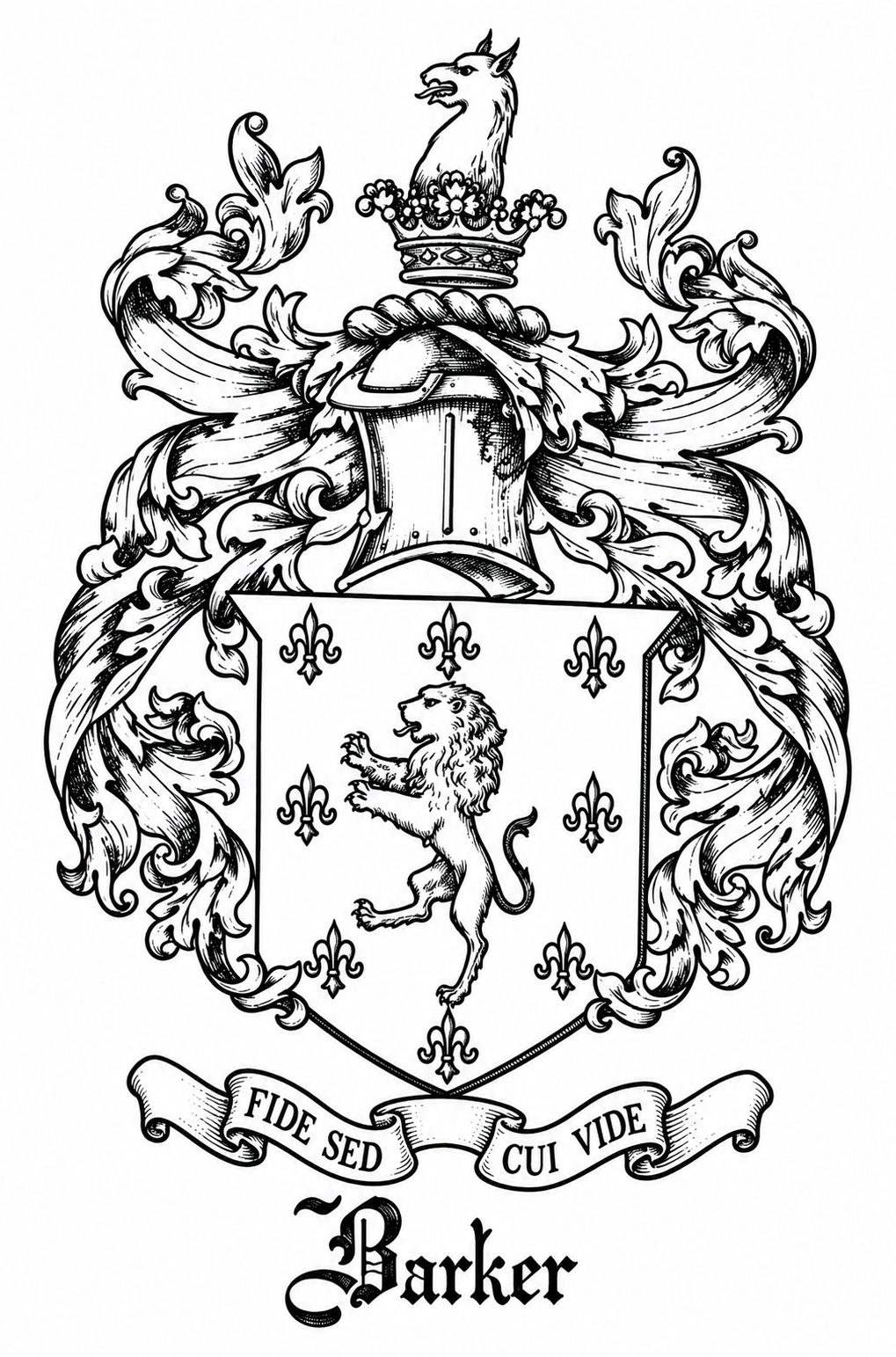
BARKER COAT OF ARMS
Barker: Azure a lion rampant argent within an orle of eight fleur de lis or.
Crest: Issuant from a ducal coronet or, a griffin's head proper.
Motto: "Fide sed cui vide." (Have confidence, but see in whom you place it.)
This is one of the very distinguished old families of England whose history can be traced back to 1200 A.D. The early ancestral seat was at county Salop, England. Sir John Barker was a member of Parliament during the reigns of Charles II and James II. Other prominent members of the family in the early days were Sir William Barker, M.P. temp. Queen Anne and Sir Christopher Barker who was with Henry VIII at Calais. There have been many distinguished members of the family in America.
The lion was a favorite symbol in the blazoning of arms and showed great strength and fortitude. An "orle" meant a wreath or ring of the fleur de lis (the French national flower). This showed a French origin and followers of William the Conqueror at the time of the Norman Invasion. The crown showed a connection with nobility, and the griffin (an unconquerable monster) super strength. Azure (blue) denoted truth and sincerity. Or (gold) was for stainless honor. The leaves are for decoration only and have no meaning.
In the time of Edward III, the family gave its name to a street in Ipswich. (As related by R. Haskins Ellis and Eleanor Lexington, Genealogists.)
Burke's Peerage—Burke's Dictionary of the Landed Gentry—mentions William Barker of Brocking Hall who was created a baronet by Charles II, 1676. The title became extinct in 1818. The baronetcy of the Barkers of Hambleton, September 9, 1165, became extinct 1708. (Do not these baronetcies, which have lapsed through want of heirs, await some enterprising American Barkers, who can prove, as well as read, their title clear!)
Sir Robert Barker, M. P. for Ipswich in the time of Elizabeth, was made Knight of the Bath at the Coronation of James I, 1602. Sir John Barker was a member of Parliament during the reigns of Charles II, James II and William and Mary. Sir William Barker sat in Parliament for Ipswich in the reign of Queen Anne.
To Robert Barker—it was he who changed the spelling from Barkar to Barker—we owe the first edition of the authorized version of the English Bible; it bears the date 1611, and is known as the King James version.
One of the family, a publisher, put these lines in one of his books:
“A Barker, if ye will
In name, but not in skill.”
There was, also, the punning device of a man barking a tree.
The family has its explorer—Collet Barker, 1784-1831; for him Mt. Barker in Australia is named. It had its meta-physician and classical scholar, Edmund Barker, who was a friend of Samuel Johnson. Its artist
Crossing the ocean, the Barkers settled in Plymouth Colony. In 1632, Robert and John Barker came over, and they and their descendants settled in Massachusetts.
The two oldest houses in New England are associated with the history of the Barker family. One was built by Robert, about 1650, at Pembroke—or to give it its old Indian name, Namassakeesett. The strength of the building caused it to be made a garrison during Philip's War in 1679. At Scituate Harbor, stands a house built in 1634 by John Williams, father-in-law of John Barker. Many generations of Barkers have lived in the house, which is still owned by a member of the family. It, too, was used as a garrison, and its massive walls are pierced with loopholes.
The first person found to be living in Andover was Richard Barker. This was in 1643, and he was one of the founders of the Church. Benjamin Barker, born 1696, bequeathed to this Church a "decent silver flagon." Isaac Barker, of Duxbury, married Judith, daughter of Governor Thomas Prence. She and her seven sisters were noted beauties of the day.
James Barker is recognized as the founder of the Barker family of Rhode Island, from whom so many of the name in America are descended. His name is listed among those in the Royal Charter to Rhode Island granted in 1663 by Charles II. In 1678, James Barker was elected deputy Governor of the Colony.
This is from a publication "The Colonial Barker Families of the United States" by Jesse J. Barker of Philadelphia, a member of the Historical Society of Pennsylvania: William Barker (de Calverhall) was the English ancestor of three separate American branches of the Barker family, tracing back to him and his wife Margaret Goulson through three separate emigrations from England to America:
I. The descendants of the oldest son, John Barker (de Calverhall), James Barker, who sailed in the ship "Mary and John" from England in 1634 and settled in Rhode Island, is the ancestor of the Rhode Island branch and a branch of the South Carolina Barker family.
II. The descendants of the second son, William, Robert and John Barker, came to Plymouth, Massachusetts, 1632, and they constitute the head of the Massachusetts branch,—and some Pennsylvania, etc.
The home of William Barker (de Calverhall) and Margaret Goulson Barker was Aston Manor, in the Parish of Claverly.
The Colonial Barker Family of South Carolina—with the Barker name continuing to the present time—1948—recognizes William Barker as its head:
"Formerly, two Barker brothers had settled in the North, one came to Virginia and one came to South Carolina" where (as Eleanor Lexington, Genealogist, tells us) "they intermarried with many prominent families,—that of Gov. Randolph of Virginia for one"—and with the Rileys (one of whom was appointed by the King of England as Commissioner of Supplies for the District of Barnwell, of the Province of Carolina, and another was a soldier in the War of 1812) ; the Ellises (one of whom was a soldier in the War of 1812 and another was a Congressman from his District) ; the Kirklands (two of whom were soldiers in the Continental Army in the Revolutionary War, and one a founder of the College which became Vanderbilt University and of which he was Chancellor for more than thirty years) ; the Pinckneys (one of whom was a member of the Convention that framed the Constitution of the United States,—and Minister to France in 1796), and the Brabhams (one of whom was a signer of the Ordinance of Secession).WILLIAM BARKER
Captain William Barker, of Charleston, South Carolina, was born in the year 1750. He was a contemporary of Richard Barker and Abigail Barker (1749) of Rhode Island. Abigail Barker died in Charleston and was buried in the old First Baptist Church on Church Street. When Cap-
Within the Chancel of beautiful Saint Philip’s Episcopal Church in Charleston, South Carolina, is an exquisite Memorial—“The Lighting of the Cross and Altar.” This Memorial is reverently dedicated to the Glory of God and in loving memory of Francis Marion Riley, son of William Allen Riley and Pauline Barker Riley of Barnwell District, South Carolina. The inscription is as follows: “Grant unto him eternal rest, O Lord, and may perpetual light shine upon him.”
While living in Charleston, Francis Marion Riley was a devoted member of Saint Philip’s Church.
Francis Marion Riley was a great, great, grandson of Captain William Barker. He was named after General Francis Marion.
In the Chapel of The Citadel, South Carolina’s fine Military Academy—“The West Point of the South”—there are Memorial Windows of rare beauty. One of these Windows—depicting “St. George, a tribune in the imperial guard of Diocletian. Most unselfish in his efforts to protect the weak and oppressed”—has been given to Colonel James Wilson Riley, Army Officer, Financier; a West Pointer who served in World War I and World War II—the soldier son of Captain William Allen Riley, a Confederate soldier, and Pauline Barker Riley, a Daughter of the American Revolution and a Daughter of the Confederacy.
Colonel James Wilson Riley was a great, great grandson of Captain William Barker.
Captain William Barker was married in the year 1780 to a young widow, Mrs. Williams (“Nancy”), of Old Barnwell District, and it was in this part of South Carolina where he spent the rest of his life. His plantation home was called “Crane Savannah”. On this plantation of many acres of cotton and corn land there was also meadow land—having a lake-like body of water or “Savannah” where many great white birds—cranes—nested,—hence the name “Crane Savannah”. This tract of land consisted of hundreds of acres and through the years on down to the present time a great part of this plantation has remained in the possession of members of the Barker family.
To William Barker and his wife, Nancy Williams Barker, four sons and two daughters were born: Richard Barker, James Barker, William Barker, Owen Barker, Holly Barker and Mary Barker.
Born in 1784, William F. Barker, son of Captain William Barker and his wife, Nancy Williams Barker, married a Cave.
Born in 1790, Holly Barker, daughter of William and Nancy Williams Barker, married Christopher Burke.
Owen Barker, son of Captain William Barker and his wife, Nancy Williams Barker, was born in 1794. He married Elizabeth Lyons after the death of his first wife, who was a Getsinger. He died in 1865.
Mary Barker, daughter of William Barker and his wife, Nancy Williams Barker, married Jesse Sanders after the death of her first husband,—a Mr. Stokes.
These sons of William Barker were planters, their chief crop—or "money crop"—being cotton. "Having acquired lands, slaves and money these planters built homes and churches befitting their now secure station in life—for the Low Country, too, had its pioneer days, its difficulties with the Indians and its battles against nature in which only the strong spirit could survive. The strong spirits did survive and in time accumulated property and wealth.
"Characteristically, the early Low Country plantation home was near or a river since that was still an avenue of transportation and communication. The house itself, of whatever material it was built, was in variably in good taste; the grounds were spacious; the shade trees and the avenues were generally live oaks or cedars. A garden was always present. It contained old fashioned shrubs and 'exotics' such as the gardenia, the oleander, the azalea and the camellia japonica. Servants' quarters, carriage houses and stables were not too far away from the Big House—with kitchen and smokehouse closer still.
From the front porch of some houses the rice fields could be seen; while on high ground was grown the corn, the cotton, indigo and the food crops.
Certainly, not everybody had such homes, but this was the pattern. It was the ideal of which everybody dreamed and it was attained by many families. It was the type of home which inevitably developed in that
Richard R. Barker, the oldest son of Captain William Barker, inherited a great part of “Crane Savannah” Plantation from his father, Captain William Barker. All of his life was spent on this plantation in Old Barnwell District—about ten miles from Barnwell Village. On this plantation was an old-fashioned two-storied white house. The kitchen was a short distance away from the “Big House.” There were many slaves—some of them “house servants”—many of them worked in the fields cultivating the food crops—corn, potatoes, vegetables of many kinds—as well as cotton, the “Money Crop.”
Richard R. Barker married Sarah Dortch, 1815. To them were born two children,—one son and one daughter:
William Ransome Barker, son of Richard R. Barker and his wife, Sarah Dortch Barker, was born on May twentieth, 1816. Mary Ann Barker, daughter of Richard R. Barker and his wife Sarah Dortch Barker, was born about 1818.
In the family burying ground are the graves made of brick with the stones giving these dates:
Departed this life the 6th
day of October, 1842.
and
Sarah Barker
Departed this life the 25th
of March, 1846.
“These planters of the South retained their independence of spirit longer than Americans of other sections because each man, with his family and his chief business, was isolated in his large domain. They ruled over subjects who had no other providence.
Their women were as distinctive as the men. Necessarily individual, isolated, independent thinkers, their duty was to provide food, warmth, clothing, medical treatment, part of the discipline and most of the religion for their own families and for one hundred and fifty to three hundred Africans fresh from savagery. Usually there was a ‘Church House’ for them; there were class leaders—the most responsible Negroes. On Sundays they had special seats at Church in the Church or Chapel of ‘The White Folks’—usually in a gallery.
The conscientious mistress, and she was in the vast majority, had no opportunity for idleness; little for rest. ‘The mistress of a big plantation, sharing with the master the responsibilities of directing and caring for the slaves, naturally developed initiative and unusual resourcefulness and independence.’”
On his father’s plantation “Crane Savanna,” the only son, William Ransome Barker, grew to fine young manhood—strong and tall—“mentally brilliant, physically magnificent”—beloved by those who thus described him. He and his only sister had private teachers. He loved to travel; he loved music and dancing. He loved beautiful horses and hunting and fishing. Most of all, he loved his home and land. Gentle with his beloved family, loyal to his friends, kind to his slaves—“Here was a man—the personification of a great era in American life . . . he stood for much that was best in the Old South.”
In 1834 he was married to Elizabeth Eve Ellis, only daughter of William Barton Ellis and his wife, Celia Elizabeth Barfield Ellis, at their plantation home “On Combahee”—on Combahee River, Prince Williams’ Parish, Beaufort District, South Carolina.
William Barton Ellis was a rice planter. The Ellises were of English descent. He was born in North Carolina, Elizabethtown, on the Cape Fear River, on February the twenty-sixth, 1772. His wife, Celia Barfield Ellis, was from Georgetown, South Carolina (her family formerly of.
Jefferson Barfield Ellis, the older son, was born in 1806. He died December 24, 1855. He married Mary Manker, of French Huguenot descent. Their plantation home was in Beaufort District. He was at one time Congressman from his District. James Ellis, son of Jefferson Barfield Ellis and Mary Manker Ellis, was a soldier in the Confederate Army. He was in the Campaign of Virginia and was badly wounded in 1862. Their only daughter, Sarah Elizabeth, married William N. May, of Edgefield, South Carolina. They had one son, Yancey May, born December 14, 1870. Jefferson Barfield Ellis and his family moved to Florida, Jefferson County. Some of the family still live there—near St. Augustine.
The second son of William Barton Ellis and Celia Elizabeth Barfield Ellis, was named William Nathaniel Heyward Ellis, after his father’s friend—a rice planter, Mr. Nathaniel Heyward. This son was born on the 12th of May, 1812. He became a very wealthy planter and a man of great influence. He was twice married. His first wife was Rebecca Pamelia Thames. Their plantation was a great tract of land in Beaufort District—not far from where the town of Brunson now stands. They had three children who lived to maturity—two daughters and one son: Julia Emily, born June 3rd, 1834, married Joseph D. Johnson, Jr., son of Congressman Johnson (their son, Wallace, went to Texas and married Emma Stone. Their daughter, Laura, married Martin Peterman of California—she died in California and is buried there; Laura, married a Pinckney, and the son, Samuel Ferdinand Ellis, was born September 26, 1836, and died August 28th, 1882. He married Elizabeth Hamilton.
Rebecca Pamelia Thames Ellis died April 22, 1850. After her death, William Nathaniel Heyward Ellis married Catherine Ann Tuten. Among the members of this family were doctors as well as soldiers and planters: Dr. William Jefferson Ellis, second son of William Nathaniel Heyward Ellis and his wife, Catherine, graduated from Furman University in Greenville, South Carolina, and from the South Carolina Medical College at Charleston, South Carolina. He practiced medicine for many years, Dr. Medicus Emmett Ellis, son of Dr. William Jefferson Ellis, was a graduate of the South Carolina Medical College in Charleston. He was a graduate of the North Carolina Medical School. He was a beloved phy-
Robert Rayburn Ellis, son of Dr. William Jefferson Ellis and Lillie Dora Flemming (formerly of Charleston, South Carolina), served in the United States Army in World War I. He went overseas with the “Rainbow Division” attached to the Medical Corps. He was stationed in France and Germany. William Jefferson Ellis, son of Dr. William Jefferson Ellis, was born in 1886, January the 18th; he served in the United States Army in World War I. He went overseas with the “Wild Cat Division”—which was the 83rd and named for a Bay near Fort Jackson, South Carolina. He was in the Infantry.
Dr. Charles Waples Ellis, seventh child of William Nathaniel Hey-ward Ellis and his wife, Catherine, was a graduate of the University of Maryland Medical School. He practiced medicine in Beaufort District for many years.
Elizabeth Eve Ellis, only daughter of William Barton Ellis and Celia Elizabeth Barfield Ellis, was born in November, 1815, at “On Combahee”, their plantation home. Her father was a rice planter.
(On Page 150, Book 26, Office of the Clerk of Court, Beaufort, S. C., “Combahee Plantation” is mentioned as being North of—northern bound-ary—of “Brewton Plantation” whose boundaries, northern and eastern, were, formerly, “Old Bras”—“Pleasant Hill Plantation” and “Combahee Plantation”). “A reproduction of a plat (of that period of adjoining lands) is shown in connection with the sketch of “Ulmer’s” or “Rose Hill” Plantation (owned by Capt. John Ulmer and Elizabeth Barton Ulmer, 1797).”
“Brewton Plantation”, as it is known today, is a part of an original
Many of the old plantations no longer exist; the ravages of time—the invasion of wars—"Revolutionary" and "The War Between the North and the South"—with Sherman's devastating march through South Carolina—the destructive gales that strike these coasts, all have wrought havoc with the plantation era of The Carolina Low Country.
Elizabeth Eve Ellis was very young when her father, William Barton Ellis, died. Her mother’s sister, Ann Marella Barfield, originally of Georgetown, South Carolina, had married Lewis Manker, of French Huguenot descent, and their plantation was in Beaufort District also. After the death of her husband, Celia Elizabeth Barfield Ellis went to live near her sister, and it was in that part of Beaufort District where her children grew up. She married a second time—a Mr. Huggins, a Baptist Minister. When she died she was buried in "Salkahatchie Church Yard" This Church (Baptist) was near the village that is now Fairfax, South Carolina. Her daughter, Elizabeth Eve Ellis, grew up to be a woman of great beauty and charm, possessing unusual executive ability. In 1834 she was married to William Ransome Barker of "Crane Savannah" plantation. When William Ransome brought his bride home the family and the slaves assembled to give them a warm welcome. One old negress—"Marm Betsy"—made her curtsy before the young mistress and said: "You is the prettiest lady in all dis land!"
For many happy years the young Master and Mistress lived at "Crane Savannah" plantation. All their children were born there. William Ransome's only sister had married Thomas Franklin Hogg and they lived on their nearby plantation.
To William Ransome Barker and his wife Elizabeth Ellis Barker were born three sons and six daughters. Through these years their plans for their new home—their "Dream House"—developed into a beautiful reality and "Sycamore Plantation" with its wide lands and its lovely white house; with its avenue of cedars and its beautiful gardens, with many, many sycamore trees about it, became a Haven for these happy people—the
2. Richard Simkins Barker
3. James Hamilton Barker
4. Sarah Cornelia Barker
5. Celia Amanda Barker
6. Ann Josephine Barker
7. Savannah Elizabeth Barker
8. Rosa Pauline Barker
9. Mary Jane Barker
2. Junius, the second son, died when just a boy.
3. Rosamond, daughter of William Ellis Barker and Mary Elizabeth Barnes Barker, died in infancy.
4. Lula, the second daughter of William Ellis Barker and Mary Elizabeth Barnes Barker, married Ira Bowers. They had one son, Ira Bowers, Jr., an outstanding citizen of Allendale County, interested always in the educational activities of his community, and a Trustee in the Allendale Schools. Rosa Lee, daughter of Ira Bowers, Jr., and his wife, was a member off the "W.A.A.C.'s" of United States Army, World War II.
5. Julia, the third daughter of William Ellis Barker and Mary Elizabeth Barnes Barker, married her first cousin, Theodore Allen. To them was born one daughter, Elizabeth Allen. She is a graduate of the University of South Carolina after a course of study at Peabody University, Nashville, Tenn. She is a graduate nurse of the University Hospital of the Medical Department of the University of Georgia. She became a nurse in the American Nurses' Corps in World War II. She was stationed at a Field Hospital in Italy for about two years. After the European conflict was over she went on her way to the Pacific Area, but was returned to the United States,—the war with Japan having ended. She is now in Florida, stationed at Jacksonville with a Demonstration Unit. Her mother, Julia Barker Allen, died when her daughter, Elizabeth Allen, was quite young. Her father, Theodore Allen, son of Emmett Allen and Mary Jane Barker Allen, was a soldier in the United States Army in the Spanish-American War. He was with the American Troops throughout the Campaign in Cuba.
William Ellis Barker was a planter, his plantation adjoining that of his father, Major William Ransome Barker of "Sycamore."
William Ellis Barker died November the fourth, 1895. He is buried in the Church Yard at Salkahatchie. His grave is marked with the Confederate Cross of Honor.
Friends and kinsmen of William Ellis Barker with whom he probably took part in the engagement at Honey Hill and with whom he served throughout the war were—Owen Riley, Benjamin Hart Moss Riley, Joseph B. Bates, Joseph T. Hogg, J. C. Kirkland—all of whom were members of the same Regiment,—3rd Cavalry, South Carolina Volunteers.
George Owen Riley and Angus Williams were in Greenville, South Carolina, at College—Furman University—and James Hamilton Barker was a student at the South Carolina Medical College in Charleston, South Carolina, when the War broke out. They came home to join the Army.
Richard Simkins Barker, second son of William Ransome Barker and Elizabeth Ellis Barker, was born the ninth of August, 1836, at "Crane Savannah" his father's plantation home. He and his brothers were taught by private teachers and as they grew older were sent to private school for boys. Two of these schools were the Beech Island School for Boys, whose headmaster was Mr. Havener—a scholarly gentleman and greatly respected, and the Boiling Springs School for Boys, whose headmasters were highly educated gentlemen such as Mr. Patrick Quinn and Mr. Thomas Colding.
Richard Simkins Barker, with his father, Major William Ransome Barker and his older brother, William Ellis Barker, and his younger brother, James Hamilton Barker, all joined the Army of the Confederate States of America in April, 1861, at Allendale, South Carolina. Richard Simkins was a 2nd Lieutenant, "Co. I"—Vince Martin as Captain, Johnson Hagood as Colonel, First South Carolina Volunteers, General Beaure-
Sure enough it was “Simmie”—their beloved soldier, Richard Simkins, wounded and sick. They took him home. He was desperately ill afterwards and his life despaired of, well-nigh. Slowly he got better, but he was so badly disabled that he could never rejoin his Company in Virginia. However, he was, for the rest of the War, on “Home Duty”—caring for the families of the soldiers who had been killed in battle; helping with the provisioning of the armies at the front, and various other important duties which were performed by the old men and those who were not able, physically, to do active service at the front. Richard Simkins was a planter. As each child of Major William Ransome Barker and his wife, Elizabeth Ellis Barker, married, he or she was given a tract of land and on the land was built a house—not large and lovely as had been built in the days before the War but, nevertheless, a home for these courageous young soldiers and their brave wives—who knew so well how to turn a house into a home, and to wrest victory from defeat. Richard Simkins Barker married Miss Mary Knight. To them was born one child, a daughter, Pauline, named for her father's beloved sister, Pauline Barker Riley.
Richard Simkins Barker died November the fourteenth, 1878. He was a Mason. He was a devoted follower of General Wade Hampton in the redemption of our beloved South Carolina—during the dark days of Reconstruction.
James Hamilton Barker, third son and third child of Major William Ransome Barker and Elizabeth Ellis Barker, was born October the twenty-third, 1838, at “Crane Savannah”—plantation home of his parents. Later, the family moved to their beautiful “Dream House”—“Sycamore Plantation”—and members of the family have lived there for many years, until the present time. James Hamilton, like his brothers, was educated in private schools,—one of them being at Beech Island, South Carolina, another, a preparatory school, at Boiling Springs, the Headmaster, Mr. Havener, a noted educator. James Hamilton was prepared for college at this school; he was a student at the South Carolina Medical College at Charleston, South Carolina. He left this school to join the Confederate Army at the outbreak of the War Between the North and the South—so he was unable to complete his medical education.
The following is the War Record of James Hamilton Barker—(it was written at his own dictation by his niece, Miss Kate Kirkland):
His father, Major Ransome Barker, went with reserves to Charleston, South Carolina, and was there about ten days, but was sent home on account of physical disability,—a severe attack of inflammatory rheumatism. He was never well again, and afterwards died—at the age of fifty-three from this disease. He and his three sons had volunteered at the same time—joining the Confederate Army in 1861.
James Hamilton, with his two older brothers, William Ellis Barker and Richard Simkins Barker, joined the Army in Allendale, South Carolina, “Company I”—Vince Martin as Captain, Johnson Hagood, Colonel, First South Carolina Volunteers, General Beauregard was in command. He arrived at Charleston at daylight, on the morning of April the twelfth, 1861, and therefore heard the first gun fired in the war—at Fort Sum-
2. Joseph S. Barker
3. William Ransome Barker
4. Meta Barker
2. Nicholas Hamilton Barker
3. Charles Benjamin Barker
4. Mary Barker, a Nurse in the Veterans Hospital in Augusta, Georgia.
5. Cornelia Barker—Cornelia is married, her husband is a Medical Missionary, they are stationed in Africa.
6. Robert Edward Lee Barker; died when but a boy.
2. James Barker
3. Mary Barker
4. Cornelia Barker
2. Hamilton ("Hammie") Langford
3. Leonidas ("Leon") Langford
4. Molly Langford
2. Eugenia Dean
3. Gibson Dean
2. Henry Cornelius Kirkland
3. James Hamilton Kirkland
4. Pauline Barker Kirkland
5. Katherine Dunbar Kirkland
2. Annie Laurie, who married Karl J. Walker of Allendale, South Carolina. They now live in Tampa, Florida, and have two sons.
4. John ("Jack"), unmarried, who is a planter in Bamberg County.
5. Edward, Jr., married a Miss Spann; lives in Bamberg County.
1. Edward Junius, who married Carrie de Treville Dunbar of Millettville, South Carolina—one son, Charles Dunbar, and five daughters together with their mother now live in Charleston, S. C. Their father died several years ago. Charles is a graduate of the University of South Carolina. Cecilia, the oldest daughter, attended Winthrop College; she now lives in New York City. Katherine Kirkland, the second daughter, is a registered nurse—a graduate of the Nurses School of the Medical College of Georgia: she served in the United States Army, overseas, the Medical Corps, World War II, in the European Area. Edwina, the third daughter, attended the University of South Carolina. June, the fourth daughter, is a graduate of Charleston College. The youngest daughter, “Polly Riley” (named for her grand-aunt, Pauline Barker Riley—Mrs. William Allen Riley) is also a graduate of Charleston College. Their great-grandfather helped, greatly, with the endowment of this splendid old College.
2. Sarah Elizabeth (“Leize”), oldest daughter of Pauline Barker Kirkland Black and Paul de Lacy Black, is a teacher in the Allendale Schools, South Carolina. They have three children, two sons and one daughter, as follows:
1. John de Lacy Snelling, who was a sergeant in the Signal Corps, United States Army, World War II.
2. William Johnson Snelling—in the Intelligence Branch of the U. S. Navy. He is now a student of the New York University.
3. Ruth Franklin Snelling, a nurse in the Medical Corps, U. S. Army. She served overseas in the European Area—first in a London Hospital,—then she was transferred to Paris.
James Hammond Black, younger son of Pauline Barker Kirkland
Mary Alice, Annie Kate, and Joseph Bates, children of Pauline Barker Kirkland Black and Paul de Lacy Black, died when quite young. Pauline Barker Kirkland Black died February 20th, 1938.
Celia Amanda Barker, second daughter of Major William Ransome Barker and Elizabeth Ellis Barker, was born the nineteenth day of January, 1843. The Barker girls were taught in their home by their governess—“Reading, Writing, Arithmetic”; also music—piano, voice and dancing. Pauline always said: “I don’t know when I learned to dance, neither do I remember when I learned to ride a horse—I always seemed to have known.” And how they loved to sing! Their father and mother took part in the happy things they all loved to do. Charleston was not far away and Barnwell was nearer still. These Barker girls were known as the “Beautiful Barker Sisters”. Celia Amanda was a gentle, lovely girl. She attended a School for Girls at Aiken, South Carolina. When very young she married Jones Angus Williams, son of Senator Jones Angus Williams. He was a student at Furman University when the “War Between the States” broke out. He left school to join the Confederate Army. To Celia Amanda Barker Williams and Jones Angus Williams were born two sons and one daughter:
1. Johnson Hagood Williams, named for General (afterwards Governor Hagood.) This son died when just eleven years old.
2. Jones Angus Williams, the second son, was educated at Patrick,
3. Julia Ellis Williams, only daughter of Celia Amanda Barker Williams and Mr. Jones Angus Williams, was born August 27, 1866. She was educated at a School for Girls in Charleston, South Carolina, and at Gordonsville, Virginia. She married Samuel Wiles Trotti Riley, youngest son of Capt. James Wilson Riley of the Confederate Army. (See "The Riley Family")
After the death of her first husband, Jones Angus Williams, Celia Amanda Barker Williams married Mr. Robert Williams.
Ann Josephine Barker, third daughter of Major William Ransome Barker and Elizabeth Ellis Barker, was born in 1845. The Governess for the Barker children took care of the little girl's education. When she grew older she attended a School for Girls in Aiken. She was very beautiful and possessed a sparkling personality. In 1874 she married Allen Hampton Brabham—born in 1848. To them were born one son and two daughters:
1. Charles Brabham. Died in young boyhood.
2. Carrie Brabham, a lovely little girl who died in early girlhood.
3. Minnie Quincy Brabham was born in February of 1876 at the plantation home of her parents,—adjoining that of her grandfather, Major William Ransome Barker, and her grandmother, Elizabeth Ellis Barker. She was educated at Meminger School in Charleston, South Carolina. She lives at North Augusta and "Sycamore".
Ann Josephine Barker died in the fall of 1881. She is buried at Old Mizpeh Churchyard. Allen Hampton Brabham died in 1891.
Savannah Elizabeth Barker, fourth daughter of Major William Ransome Barker and Elizabeth Ellis Barker, was born the fourteenth day of September, 1847. She was educated at home by her governess and when she grew older she attended a School for Girls in Barnwell, South Carolina. She was a pianist of unusual talent and a young woman of great charm.
The wedding of Savannah Elizabeth Barker and Joseph B. Bates and of Rosa Pauline Barker and William Allen Riley was a Double Wedding which took place at the beautiful little Chapel where the Barker and Riley families worshipped.
Joseph B. Bates and Savannah Elizabeth Barker Bates had no children. But their home was ever a haven for boys and girls whose parents—father and mother—or both, had died. Lena and Kate Kirkland, who died while two lovely daughters of Sarah Cornelia Barker Kirkland, were still young, were lovingly and gently cared for, as was Minnie Brabham another niece, by this kindly couple. Other children, also, were befriended by them and taken into their hearts and home and treated as their own. Theirs was truly a home of beautiful hospitality.
After the death of Joseph B. Bates, Savannah Elizabeth Bates went away from this old plantation home and lived for the rest of her life at her lovely suburban home in North Augusta, of Augusta, Georgia. She died June eighteenth, 1922. She and her husband are buried in the Churchyard of the Methodist Episcopal Church at Millettville, South Carolina,—a church which they helped to build. It is near their old plantation home. Kate Kirkland, their beloved adopted daughter, is buried there beside them. As one enters this quiet Church Yard the sound of the soft wind through the pines is as a requiem for them and so many of their loved ones resting there.
Rosa Pauline Barker, fifth daughter of Major William Ransome Barker and his wife, Elizabeth Ellis Barker, was born the first day of November, 1850. Her beloved father and mother and her efficient governess made "going to school" a joyous thing to the lovely little girl. Under their gentle guidance she learned "Reading and Writing and Arithmetic" as an accompaniment to Music and Dancing and Riding. (See—"The Riley Family")
Mary Jane Barker, youngest daughter of Major William Ransome
"War! War! War!"
Battles on land and sea. Men and boys of the Low-Country falling in the Low-Country; falling at New Orleans, at Vicksburg, on Virginia Battlefields, at Gettysburg—spending all they had to spend of fortune and of life for their State. Hardship—Attrition—Defeat. The industrial civilization victor over the agricultural civilization! Property, institutions swept away. Hope itself all but gone! Then the "Tragic Era," some call it, came with frightful threat against all that was left. The old life of the Low-Country vanished.
And so ended the day of happy childhood for the three little Southern girls, Savannah Elizabeth, Rosa Pauline and Mary Jane Barker: a day representing the Old South and its institutions—the great wide lands handed down from father to son; the slaves handed down, as property, from father to son—their welfare a trust; the open-hearted, open-armed hospitality that was the established order; the gay chivalry that was a heritage; the earnest, kindly gentlemen and gentlewomen of "the old school".
Through the terrible years of warfare, through victory and defeat, those three little Southern girls, as best they could, worked side by side with their older sisters and their heroic Mother. Like thousands of other brave Southern women, they "sustained and conserved life at home and enabled the Confederate forces to keep the field".
They "learned to card and spin and knit—for supplies of clothing of all kinds rapidly diminished as the war continued—and ingenious as the women were in planning substitutes for accustomed foods, they excelled themselves in the matter of providing clothes and many of the necessities.
. . . As the awful years of warfare went by incredible hardships were borne by all".
And then came the years of Reconstruction. "To the people of South
"To the glory of military prowess a conquered people now added the dignity of quiet courage and self-respecting endurance of privation and humiliation. The spirit of those gallant "Girls of the Sixties" who went their new and untried way with courage and determination! What great hearts were theirs who could step into an uncharted future, not unafraid, but courageous and daring. Learning to accomplish the most menial tasks with dignity; laboriously fitting their hands and lives into new grooves, leaving to us who have come after them a heritage rich in all those finest things that go to build the characters that men call great!"
Rosa Pauline Barker was married to William Allen Riley of "Fiddle Pond Plantation", Barnwell District, South Carolina, on January twelfth, 1871. He was a soldier in the Confederate Army—Percival's Independent Infantry, also a Captain of a Red Shirt Company under General Wade Hampton in the Campaign of 1876—in the redemption of South Carolina from Radical domination.
The Double Wedding of the two Barker girls, Savannah Elizabeth and Rosa Pauline, was solemnized at the lovely little Chapel where the Barker and Riley families worshipped. The Reverend Mr. W. A. Clark performed the ceremony. (See Sketch "Rosa Pauline Barker Riley") also—("The Riley Family").
Mary Jane Barker married Emmett Allen of Allendale, South Carolina. To them were born two sons, Theodore Allen and Arthur Allen. Arthur died in infancy.
After the death of her first husband, Mary Jane Barker married Col. Benjamin R. Lewis. To them were born two sons, Benjamin R. Lewis, Jr., and Samuel Joseph Lewis, and one daughter, Marie, who died in infancy. Their home was at Sycamore Plantation for many years, but after the death of her second husband, the mother and the two younger sons moved to Augusta, Georgia, and lived at her suburban home in
Samuel Joseph Lewis was a graduate of the University of Georgia Medical School. He was a soldier in the United States Army in World War I. He has practiced medicine in Georgia and South Carolina for many years. His home is in Augusta, Georgia, where he is a beloved physician. He married Mary Sheets of Augusta, Georgia. They have one son, Joseph, Jr., and one daughter, Mary.
Benjamin R. Lewis attended Clemson College, South Carolina. He was a soldier in the United States Army in World War I. After his return from Europe, he would not, for a long time, talk about his experiences during his service overseas. Finally, however, when he was asked to give his record as a soldier (for this writer to use in this Sketch of the Barker family) the following is what he gave:
“I received a letter from Joe a few days ago asking me to mail you my war record. I don't know just what you want, however, I will do my best and will be as brief as possible. I entered the service Sept. 21, 1917, at Charlotte, N. C., was sent to Camp Jackson, S. C., for a short period of time and from there to Camp Sevier, Greenville, S. C., where I received my training for overseas duty. Left Camp Sevier the latter part of April for Camp Mills, Long Island, and sailed May 11th for Liverpool, Eng., and from there direct to France. We received additional training in France and later saw our first active duty in Belgium. From then until the Armistice my outfit was either in the lines or immediately back for short rest periods. Battles and engagements listed on my discharge are as follows: Ypres, Hargscourt, Montbrehain, and Vaux Andigny. Of course, we were at the breaking of the Hindenburg Line and one of those names above covers one of the points on this Line. I received no wounds or decorations of any kind nor sick a day while overseas. My highest rank was corporal; was with the 30th Division, Co. “C” 118th Infantry Regiment during all my service in the Army. Came back to Camp Jackson. Arrived at Charleston March 18th, 1919, and received my discharge April 4, 1919.”
Benjamin R. Lewis married Martha (Mattie) Weathersbee of South Carolina.THE BARKER FAMILY OF SOUTH CAROLINA
Name
Vol
Date
Page
Sara Barker
2 (G)
1729—1731
20
Joseph Barker
1
1692—1693
65
Mary Barker
1
1721—1722
16
Charles Barker
and his wife, Ellen7
1752—1756
316
"Mulberry Castle is one of the few buildings of brick laid up in English bond now standing in the low country outside of Charleston. There
“Each of the towers has a pointed roof, surmounted by an iron vane six feet high of delicate arabesque design upon which turns, as a weather cock, a plate of iron out of which the date, 1712, is cut. Above this date the vane is topped by a royal crown.” (Shaffer). Mulberry Castle Gardens are famous for their camellias.
About 1820, Mulberry Castle became the property of Thomas Milli-ken and through his daughter, who married Samuel Barker, it passed to their son, Major Theodore Gaillard Barker. Theodore Gaillard Barker was born in Charleston, South Carolina, August 24, 1832. He was a descendant of James Barker of Rhode Island. He was educated in Charleston and at the South Carolina College, Columbia, South Carolina. Theodore Barker was Adjutant General of the Hampton Legion and later of the Hampton Cavalry Division with the rank of Major. He was a handsome man of marked intellectual ability, great wit and distinguished presence. In civil life, he was prominent as a lawyer.
Major Barker was always proud of having reclaimed and successfully planted several plantations on Cooper River and Pon Pon, but his chief pleasure was in Mulberry. His management there was not only successful, but beautiful in its kindness and hospitality. His citizenship was tested again during the years of Reconstruction. He was the organizer of, (on July 30, 1869) and first captain under the name of President, the Carolina Rifle Club. This was so brave a gesture, so needed and effective an organization, that it deserves a brief note. A modified form of the famous Ku Klux Klan had been tried and proved too cumbersome and liable to be abused. Ward organizations lacked cohesion, so the organizers decided to
As resistance to misgovernment grew, Major Barker continued—under his old Commander, Wade Hampton—the work of saving the State in 1876.
Major Barker and his lovely wife, who had been Louisa Preston King, were childless, but the kin of both families were at home in their town house on Tradd Street. All young people loved the Major, and his long service as President of the St. Cecilia Society brought him into sympathetic connection with the children and grandchildren of his friends and neighbors. As each year brought another bride to go down to supper on the President's arm, a new body of young fellows in their first (or their father's) dress suits, a new body of young fellows in their first (or their father's) dress suits, and girls in muslin or silk and grandmother's topaz necklace, were there to be presented to the Major and to Mrs. Barker in her lovely lace cap with lappets; so each year he recognized them as his friends and never forgot them.
Major Barker was also President of the South Carolina Jockey Club and was in office in 1900 when the dissolving club gave its property, valued at $100,000.00, to the Charleston Library.
In the Church Yard of the old First Baptist Church—organized 1683—is a tombstone with the following inscription:
Mrs. Abigail Barker
Relict of Richard R. Barker
Daughter of
William M. and Sarah Rogers
of Newport
J. Sanford Barker
of this City.
She was born in Rhode Island
on the eighteenth of July 1749
and died of the yellow fever
in Charleston on the 27th of
September, 1797.
Her virtues many,
her manners were amiable
Her Piety unaffected, fervent
and refined.
Filial affection has erected
this Stone."
____________________
Abigail Barker and Richard R. Barker were the great-grandparents of Theodore Gaillard Barker.
Major Theodore Gaillard Barker, Major William Ransome Barker and his soldier sons, Lt. Richard Simkins Barker and Lt. James Hamilton Barker, were kinsmen and friends, comrades in arms in the Confederate Army, devoted followers of Hampton in "The Tragic Era"—worthy sons of Carolina. (Encyclopedia of American Biography, American Historical Society, Inc.) (Wallace.—History of South Carolina Biographical —Vol. IV).
—— ★ ——